
Guides / illustrated walkthrough
Jev Guardrails in Production: A Five-Step Playbook for Decision Automation
A whiteboard walkthrough of Jev as production guardrails: the System One / System Two split, Choice/Score/Noul at 70–500ms, the five-step integration playbook, $0.042/M input pricing — and the honest 74.1% vs 67.8% accuracy table that shows why thresholds and human review paths are the real work.
Quick takeaway
This whiteboard explainer makes the production case for Jev as a guardrail layer. The problem framing: most agent failures are not spectacular — a classifier misreading a ticket, a chatbot that cannot flag its own uncertainty — and forcing a “System Two” reasoning model to make millisecond “System One” decisions is like convening a panel of philosophy professors to sort your mail. Jev answers with typed decisions: Choice (one of up to 255 options), Score (an ordered rating), and Noul (a yes/no probability), evaluated in a single parallel pass at 70–500ms. The five-step playbook: request access, design rigid decision schemas instead of prompts, set confidence thresholds per decision, plan for REST constraints (no chat-completions compatibility, text and JSON only), and keep a human review path from day one. Pricing is $0.042 per million input tokens with output unmetered. The honest section: on a complex invoice-processing benchmark a frontier LLM hit 74.1% against Jev’s vendor-reported 67.8% — “can’t hallucinate” means well-formed answers, not correct ones. Which is precisely why the playbook ends with thresholds and human review. Note: the video describes Jev as wait-listed; the evaluate endpoint is self-serve today, and Ollama 0.35 now offers a local route.
Video source
200OK Solutions
Step-by-step walkthrough
- 1
Name the real problem: burning a full LLM on a millisecond decision
The video opens on the mundane reality of agent failures: a classifier misreading a standard support ticket, a chatbot that writes a beautifully plausible answer with no built-in way to flag its own uncertainty. These quiet failures degrade UX and bloat compute bills. The sharpest framing: using a chatty general-purpose LLM for a yes/no routing decision is “like calling in a panel of philosophy professors just to sort your daily mail” — too slow, too expensive, and the wrong tool for the job.
The routing question is a System One problem; chat models are System Two tools.Watch at 1:02 - 2
Meet the maker: a System One model from RLHF lineage
TypeSafe is a San Francisco lab founded by Diogo Almeida — a former OpenAI researcher who co-invented RLHF, the technique behind ChatGPT’s training. They came out of stealth with a $40M seed on a simple premise: a lot of real-world AI usage isn’t generation at all — it’s support routing, fraud scoring, moderation. System One means fast, intuitive decisions rather than generated prose: the model’s whole job is to react instantly, not to converse.
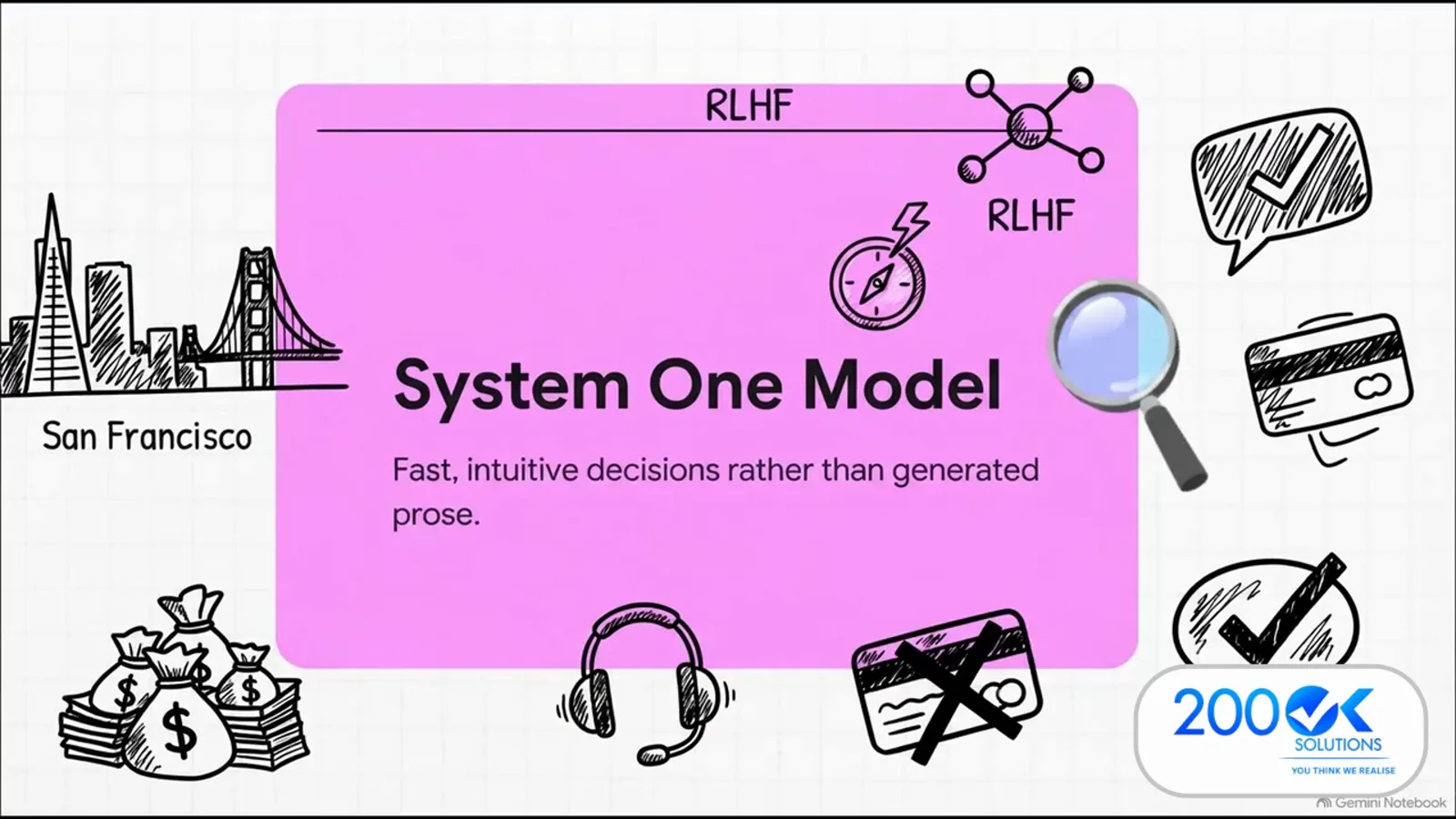
RLHF pedigree, System One purpose: decisions, not paragraphs.Watch at 1:22 - 3
Three typed outputs: Choice, Score, Noul
Jev evaluates a state — a block of text, a JSON file, an array — and returns strictly typed decisions with confidence. Choice picks one option from up to 255 possibilities and returns a probability for each (ticket → billing/technical/sales). Score rates against an ordered scale you define (urgency 1–5). Noul is a calibrated yes/no probability: ask “Is this a refund request?” and get 0.83 back. Three primitives, all bounded — your code branches on values, never parses prose.
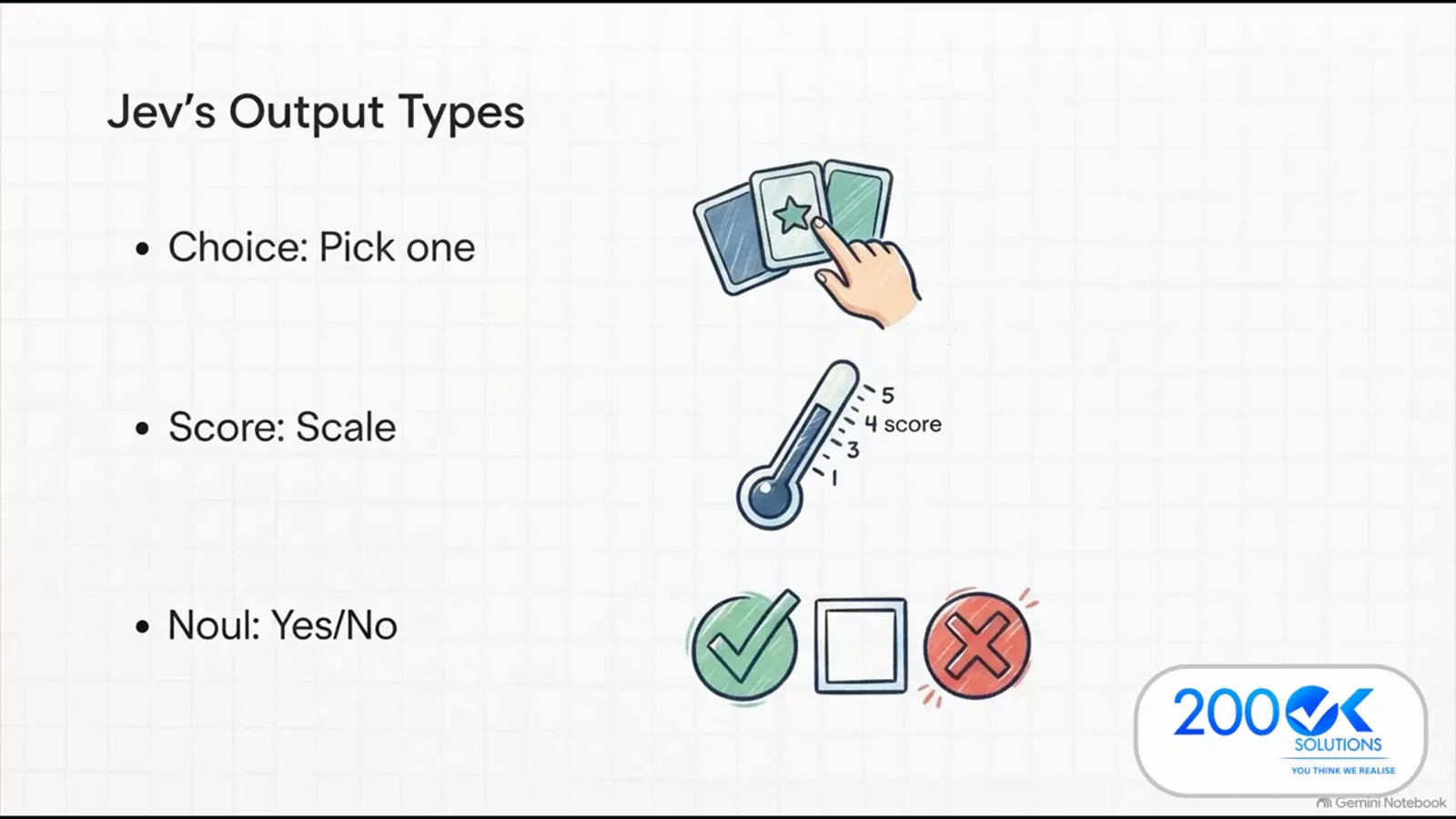
Choice, Score, Noul: every output is a value your code can branch on.Watch at 2:02 - 4
Why it’s fast: one parallel pass, 70–500ms
A standard LLM makes one autoregressive call per question, generating tokens it will then parse. Jev evaluates several typed questions on the same input in a single parallel pass — no generation step — landing answers in 70 to 500 milliseconds. That is a fraction of chat-model latency, and it is the property that lets a decision gate sit on the hot path of every message rather than in an offline batch job.
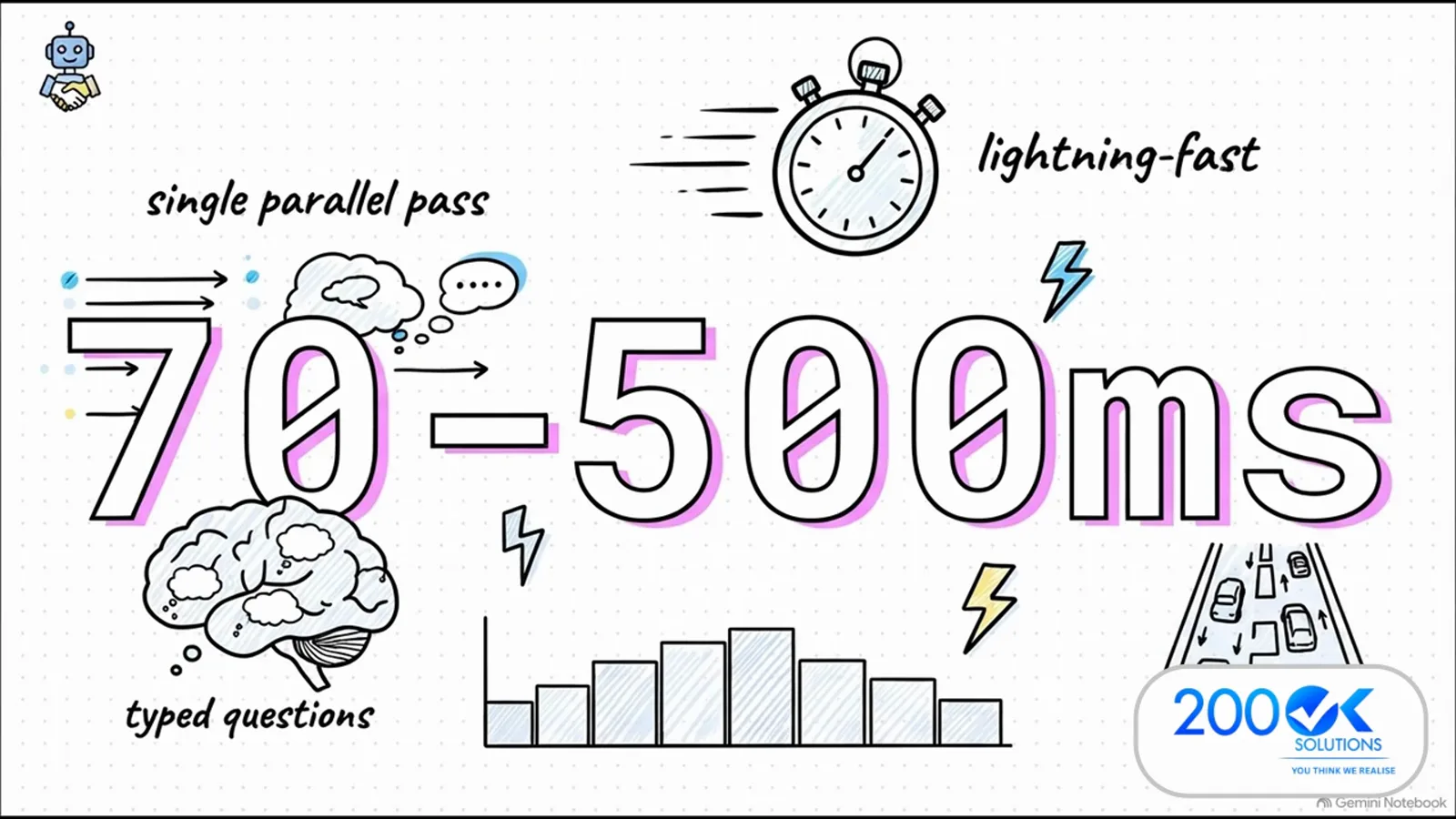
Parallel evaluation of typed questions — the 70–500ms claim explained.Watch at 2:58 - 5
Where it lives: checkpoints, not the planner
Jev is not here to replace your reasoning model. In agent architectures, every decision point — classify this, route that, is this step done — otherwise costs another expensive LLM call. The hybrid pattern: hand the repeated structured checks to Jev as checkpoints and routing gates, and reserve the expensive frontier model for complex open-ended planning and multi-step reasoning. Division of labor, not replacement.
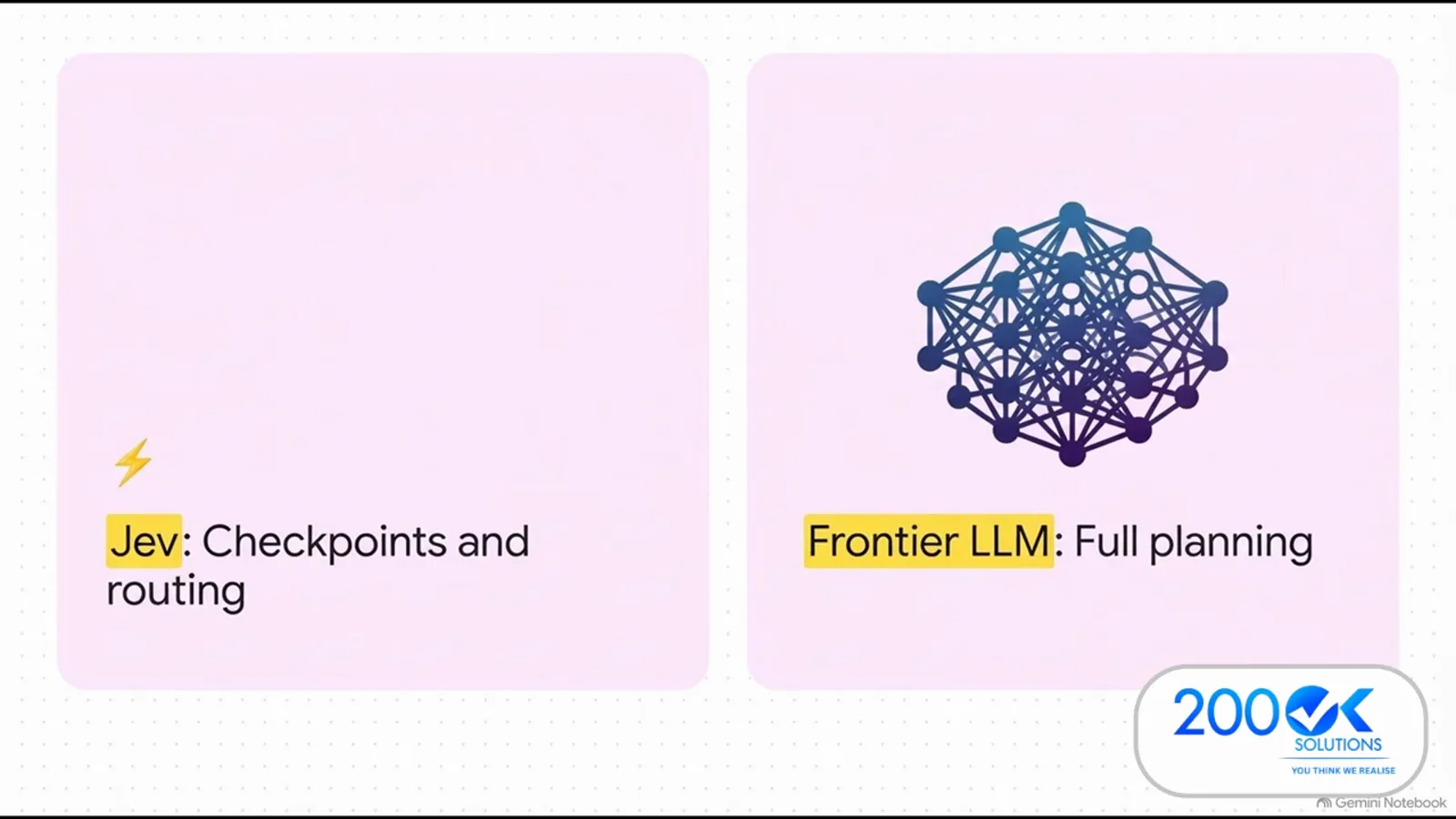
Jev takes the checkpoints; the frontier LLM keeps the planning.Watch at 3:35 - 6
The five-step integration playbook
The practical core of the video. One: request access (the video’s source material describes a waitlist — today the evaluate endpoint is self-serve, and Ollama 0.35 adds a local route). Two: shift from conversational prompts to rigid decision schemas — tickets become state, outputs become a Choice or Noul. Three: set confidence thresholds per decision — an auto-approved refund needs a higher bar than ticket routing. Four: plan for REST API constraints — Jev is not compatible with the OpenAI chat-completions format and accepts strictly text and JSON, no audio or images. Five: keep a human review path open from day one.
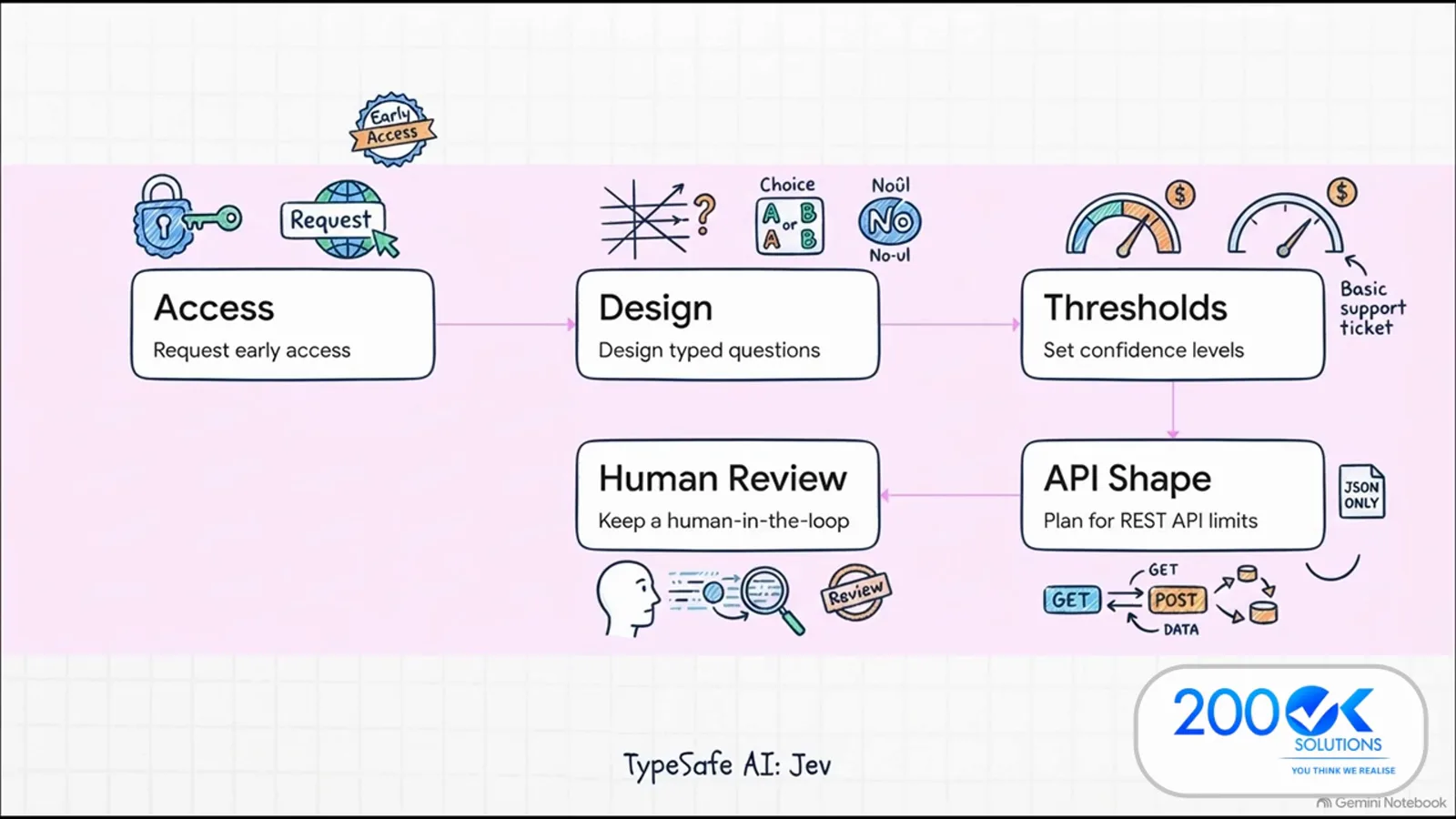
Access → Design → Thresholds → Human Review → API Shape.Watch at 4:02 - 7
The pricing that makes volume practical
$0.042 per million input tokens, and output is unmetered — because nothing is generated. At routing volume (thousands of agent interactions a day), the guardrail layer costs pennies while absorbing the decisions that would otherwise each pay full generation prices. That cost profile is what makes it realistic to check every message instead of sampling.
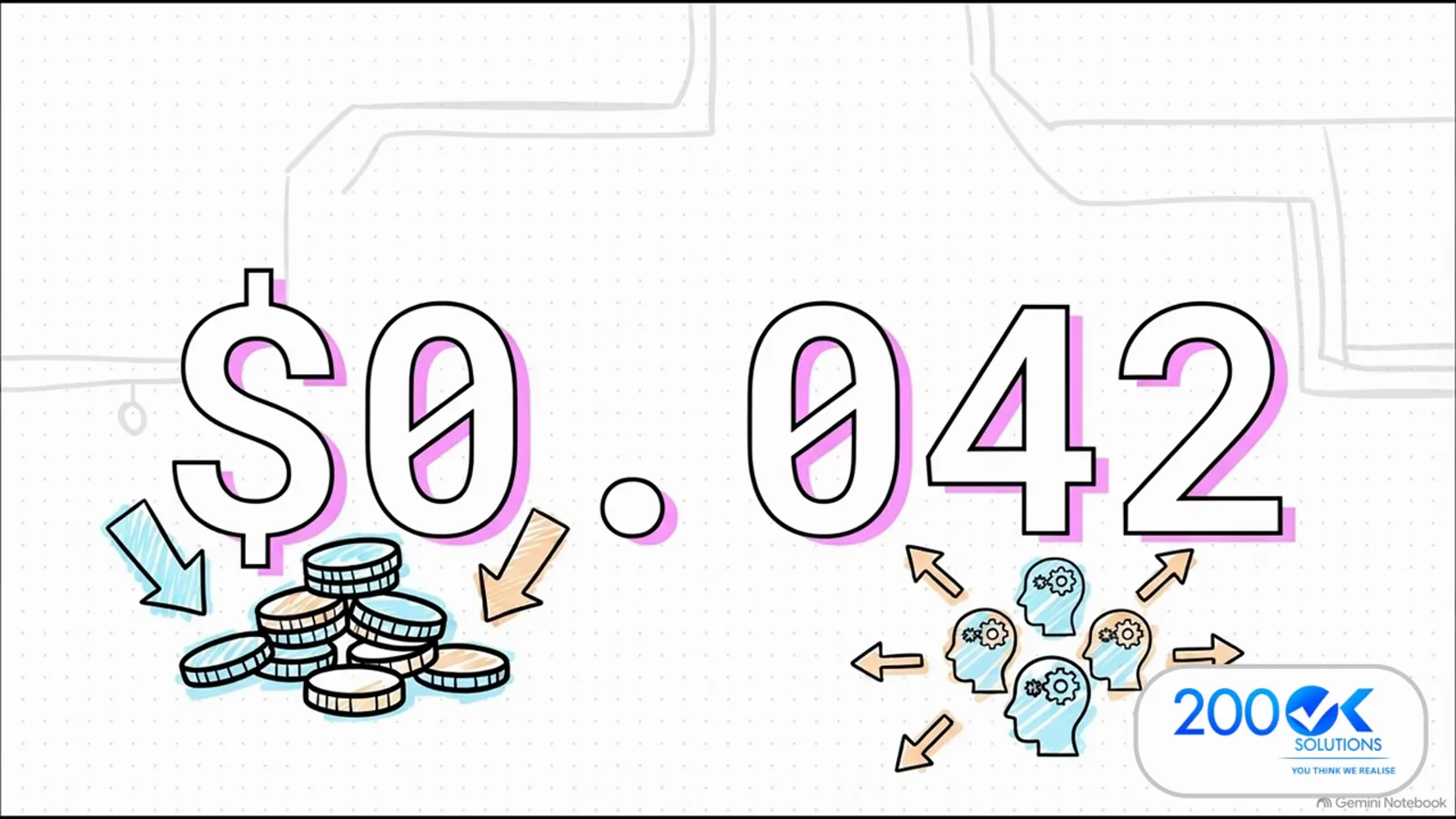
$0.042/M input, output free — check every message, not a sample.Watch at 5:07 - 8
The honest table: where Jev trails frontier accuracy
The video’s most valuable minute is the trade-off table: output (text vs typed), cost (high vs low), and accuracy — where a traditional LLM hit 74.1% on a complex invoice-processing comparison against Jev’s vendor-reported 67.8%, roughly 17 points behind on heavily structured tasks. The takeaway is precise: Jev’s “can’t hallucinate” means it won’t return malformed or broken answers — it does not guarantee the decision itself is correct. Configure thresholds so low-confidence, high-stakes calls go to a human until you have validated accuracy on your own data.
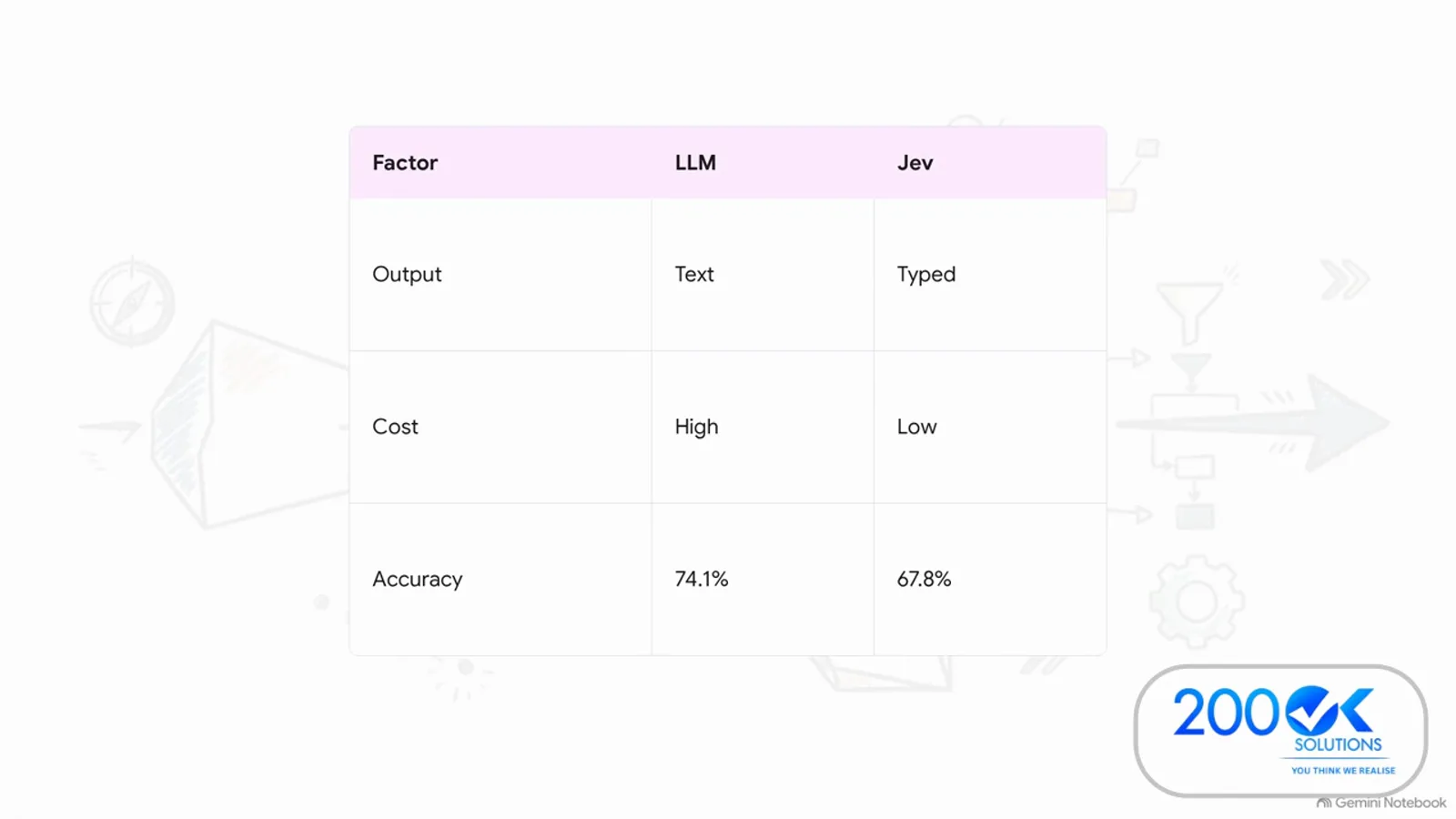
74.1% vs 67.8% on invoices — the number that justifies steps three and five.Watch at 5:22 - 9
The 200OK reality check: this is architecture work
The video closes on the point its own channel keeps making: integrating a decision layer is not swapping API keys. You have to decide where confidence thresholds live, how they are audited, and which fallback path catches the model when it is unsure — thresholds, auditing, fallback paths, backup/emergency routes. The closing question is the right one to steal: how much latency and cost are you absorbing by forcing deep System Two reasoning onto simple System One problems?
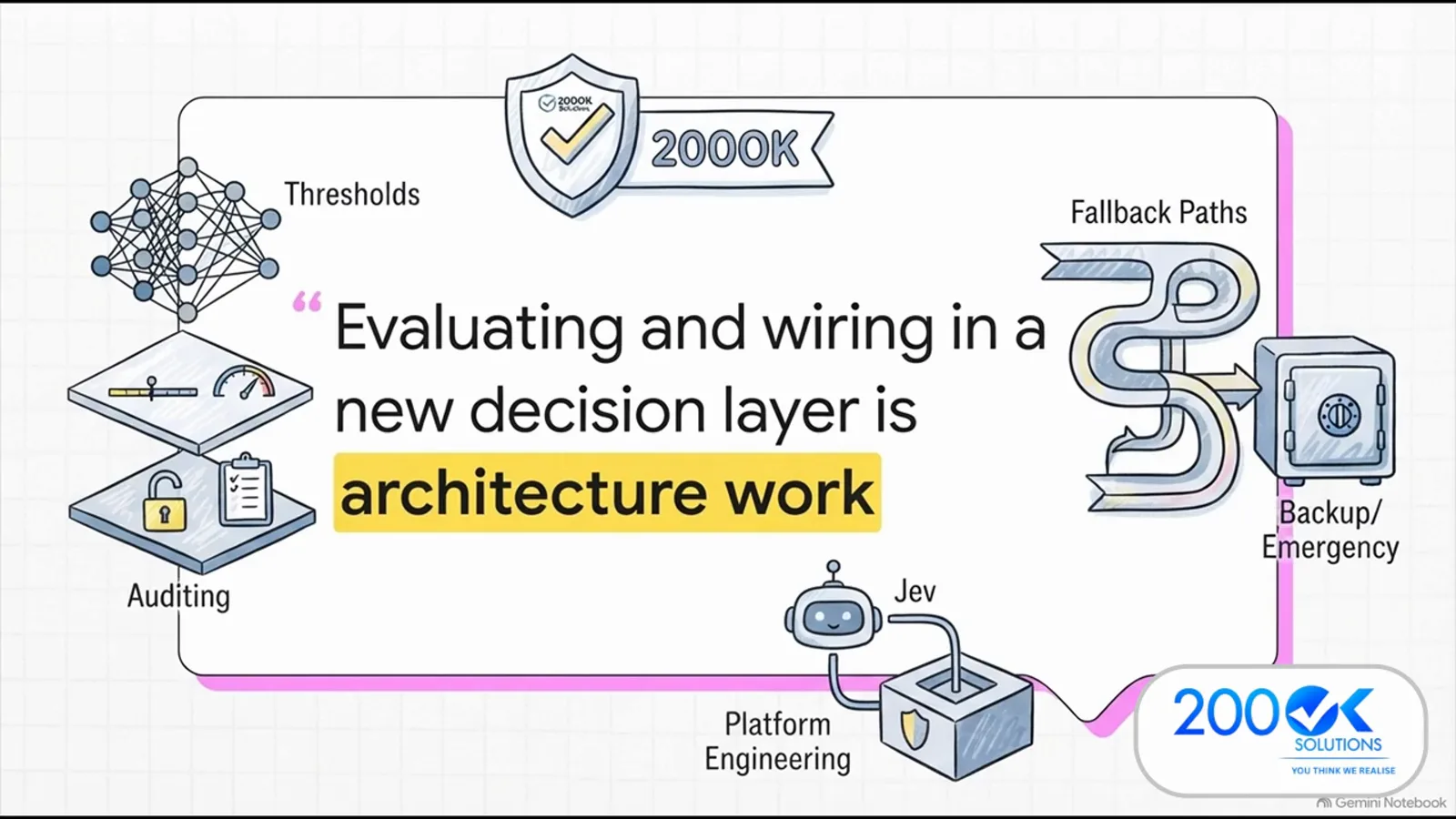
Thresholds, auditing, fallbacks — the guardrail is the architecture.Watch at 6:22
Frequently asked questions
What are Jev guardrails, exactly?
Typed decision gates placed in front of or inside an agent workflow: instead of asking a generative model to “decide” in prose, you send state to Jev and get a Choice (one of your options, with per-option probabilities), a Score (ordered rating), or a Noul (yes/no probability) in 70–500ms. The guardrail part is the policy around them — confidence thresholds per decision, human review for the low band, and fallback paths — which is what the five-step playbook formalizes.
Is Jev wait-listed or generally available?
The video’s source material describes a waitlist, but that framing is dated: the evaluate endpoint is self-serve today, and the 2026-09-29 Ollama 0.35 release added a local route (tev1 and Nimble models through a /v1/systemone endpoint) for teams that want the same shape on their own hardware. The REST constraint the video flags still applies — this is not a chat-completions-compatible API.
How do I choose confidence thresholds?
Per decision, not globally. The video’s example: an auto-approved refund needs a much higher confidence bar than routing a ticket to a queue, because the cost of a wrong auto-action differs by orders of magnitude. Practical sequence: log real traffic with probabilities, measure your false-positive rate at candidate thresholds (the way the 30-ticket tests in our other guides do), then set the auto-action line and route the band below it to human review.
Does Jev’s “no hallucination” claim mean its decisions are always right?
No — and the video is explicit about it. On a complex invoice-processing comparison, a frontier LLM reached 74.1% accuracy while Jev reported 67.8% (a vendor-reported figure). “Can’t hallucinate” means the output is always a well-formed typed value from your option set — there is no malformed text to parse — but the value can still be wrong. That is exactly why thresholds and human review are steps three and five of the playbook.
What are the integration constraints to plan for?
Four from step four of the playbook: Jev is not compatible with the OpenAI chat-completions format, so existing LLM client code does not drop in; the API accepts text and JSON state only (no audio, no images); every call is REST over HTTPS; and output being unmetered does not make input free — at $0.042/M tokens, state design (what you include in the state) is your main cost lever.
How does this differ from prompt-injection defense?
Different threat models on the same primitive. Prompt-injection defense uses Jev to inspect untrusted input before it reaches a generative model — an attack-facing gate. This guide is about decision automation: routing, scoring, and approval gates inside your own workflow. Production systems usually ship both: the injection gate screens what comes in, the decision guardrails govern what happens next. They also share the same operational pattern — calibrated confidence with a human review band.
Related guides
LLM Prompt Injection Defense with Jev
The attack-facing gate: inspect untrusted input with a zero-generation Choice before it reaches your LLM.
ReadConfidence-Gated Fallback Chains
The production pattern for step five — what happens below the threshold, and where the low band goes.
ReadWhen to Use Jev: the Evaluation Guide
The selection framework behind step two — which of your decisions are System One problems at all.
ReadJev vs OpenAI Decision API (Luna)
The vendor landscape for the guardrail layer — contracts, latency, and pricing side by side.
ReadMore video walkthroughs
- Jev Classification Quickstart: OpenRouter API, Primitives & Real Probabilities
- Jev Architecture Explained: Why 70ms Decision Models Beat LLMs for Workflow Automation
- Ultra-Fast Browser Agents with Jev: 178ms DOM Loops & Dual Model Orchestration
- Open Jev Models Are Here: Semif, Nimble, Decider, DiffusionGemma & Laya Hands-On
- Jev vs LLM: Will Jev Replace LLMs? Krish Naik's Whiteboard Explainer
- Jev Trader Tutorial: Build a Subsecond AI Trading Bot on Monad
- Jev Model Router: Build a Privacy-Gated LLM Router with Jev & OpenJev
- Jev Tutorial for Beginners: State, Questions & the TypeScript SDK
- Run Jev Locally: Kev, SemIf & Von on Your Own GPU (OpenJev Guide)
- Jev RAG Reranker: Policy-Steered Reranking for Retrieval-Augmented Generation
- When to Use Jev: An Engineer's Audit of Claims, Gates, and Failure Modes
- LangChain + Jev Integration Tutorial: Routing, Guardrails & Evals
- Jev MCP Server: Connect Jev Decisions to Claude Code & Cursor
- Jev vs Luna: Independent Benchmarks Put "Better, Faster, Cheaper" to the Test
- Jev Agent Harness: Where the Decision Gate Sits in Your LLM Loop
- Jev Playground Walkthrough: The Hotdog Lesson, Criteria, and a Four-Console Token Test
- Jev Text Classification API: Zero-Shot CLI & REST with classifier.dev
- Jev API Examples: First Request, curl & All Three Question Types
- Jev Log Triage with Expanso Edge
- Jev Lead Enrichment with Treg: ICP and Signup Scoring
- Use Jev Decision Nodes in Heym for Model Routing
- Laya Tutorial: Open-Source AI Routing With Calibrated Probabilities (Laya vs Jev Setup)
- Train Your Own Jev: Fine-Tune a Jev-Style Decision Model for $5–$17 (What You Can and Cannot Train)
- Jev Tips: 8 Best Practices for Better Decisions (State, Questions, Criteria & Thresholds)
- Jev Context Compaction: Prune AI Agent Memory Without Generative Summaries
- Jev as an LLM Judge: Confidence-Gated Cascades at 0.36% of the Cost
- TypeSafe Computer Use: Local Desktop Automation with Jev, Step by Step
- Jev Resume Screening: Build an AI Resume Evaluator with the Jev JavaScript SDK
- Jev + Claude Code Guide: Voice-Controlled Browser Automation with Typed Decisions
- Jev vs Ollama: Can Local AI Replace Hosted Jev Without Sending Your Data Away?
- Build Your Own Jev: Train a Free Open-Source Zero-Shot Classifier (That Plays Doom)
- CUA-S1-Forms: a 706K-Parameter Jev-Like Model That Fills GUI Forms on Your CPU
- NOC/SOC Alert Triage with Jev: Rules First, One Typed Question, a Policy Gate
- Ollama Decision Models: Run tev1 and Nimble Locally (Tested on an 8 GB Card)
- A Session Drift Guard for Pi Agent: Let the Jev Model Propose, Let Code Decide