
Guides / illustrated walkthrough
Use Jev Decision Nodes in Heym for Model Routing
Configure a Heym workflow with Jev for typed language checks and runtime model routing, then inspect the decision path in execution traces.
Quick takeaway
The walkthrough configures a Jev decision model in Heym, tests a language question with English and Spanish input, and reviews an orchestrator trace where the selected model changes by task. Treat the displayed probability and trace timings as one demo run, not a general accuracy or performance benchmark. Verify fallback behavior, provider access, and thresholds in your own Heym version before relying on them in production.
Video source
Heym
Step-by-step walkthrough
- 1
Separate normal model criteria from the routing fallback
The Heym credential editor lists distinct model options with a short “Use this when” description. One option is marked for use when routing fails. Keep that fallback role explicit, choose task criteria that are easy to tell apart, and test how your deployed workflow behaves when the preferred route is unavailable; the video does not establish a universal failover guarantee.
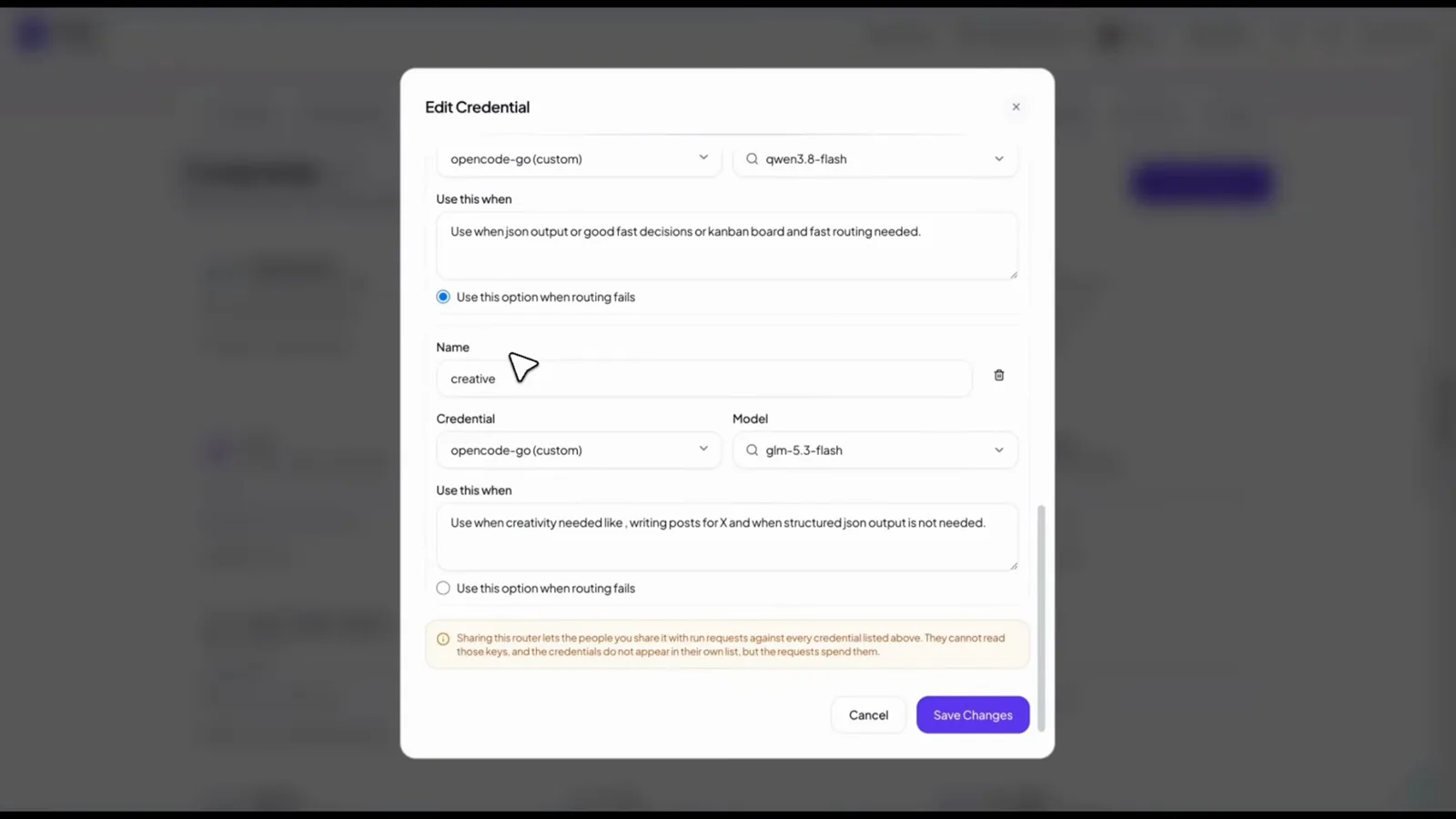
Make the fallback role visible instead of hiding it in a broad model description.Watch at 1:08 - 2
Run a Spanish sample through the language-check workflow
The video enters “¡Hola!” as a contrasting input and runs the Heym workflow. This frame captures the Jev Decision node while it is still executing; use the next frame to inspect the completed branch before connecting it to a consequential action.
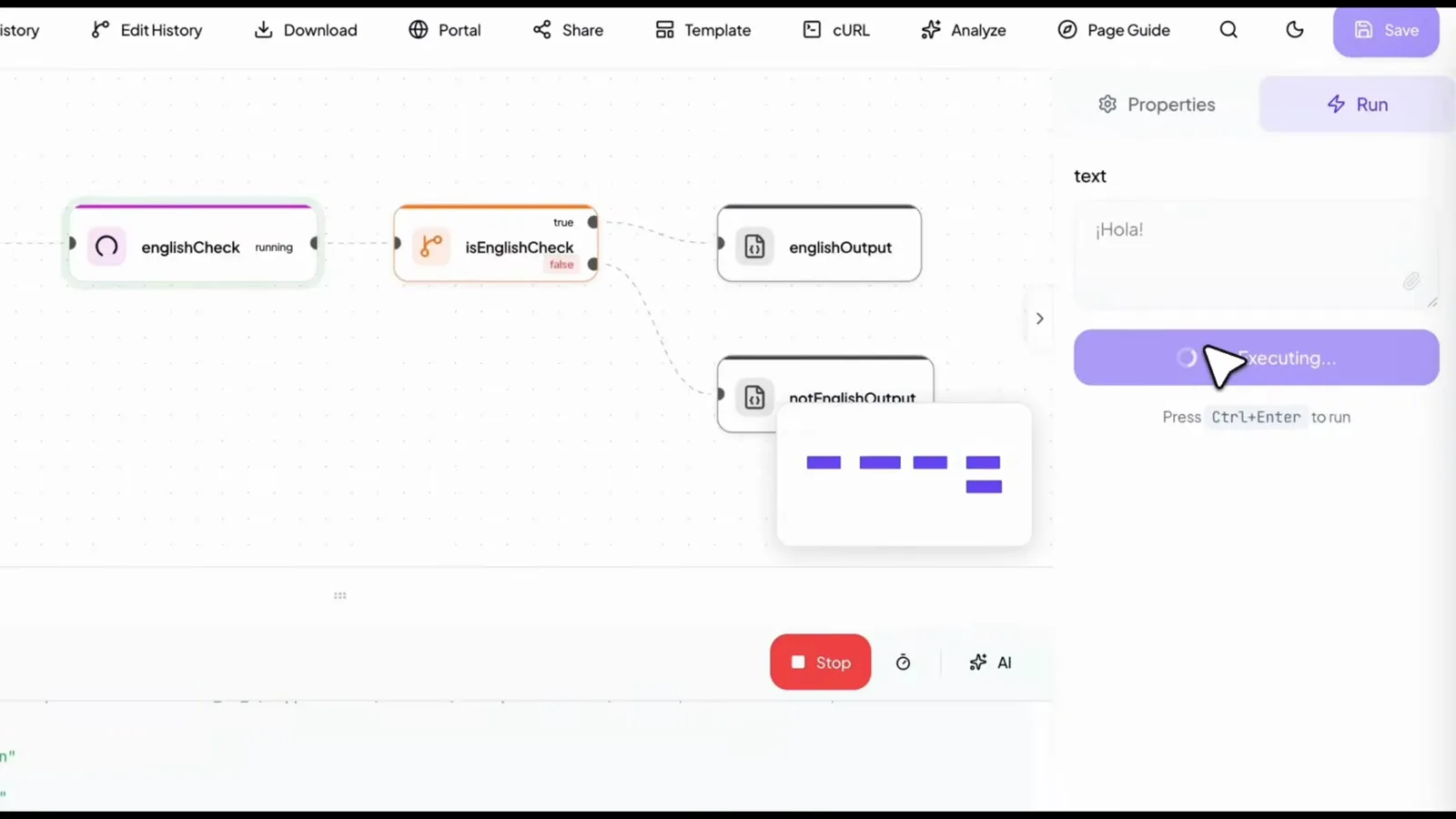
The execution indicator is still active in this frame; the result appears moments later.Watch at 1:32 - 3
Check the completed result and its conditional output
The execution highlight shows “Not English” with probability 0.03, and the workflow connects the false side of `isEnglishCheck` to `notEnglishOutput`. This is one example response, not an accuracy claim. Validate the question criteria and downstream actions with labeled cases, including short or ambiguous text.
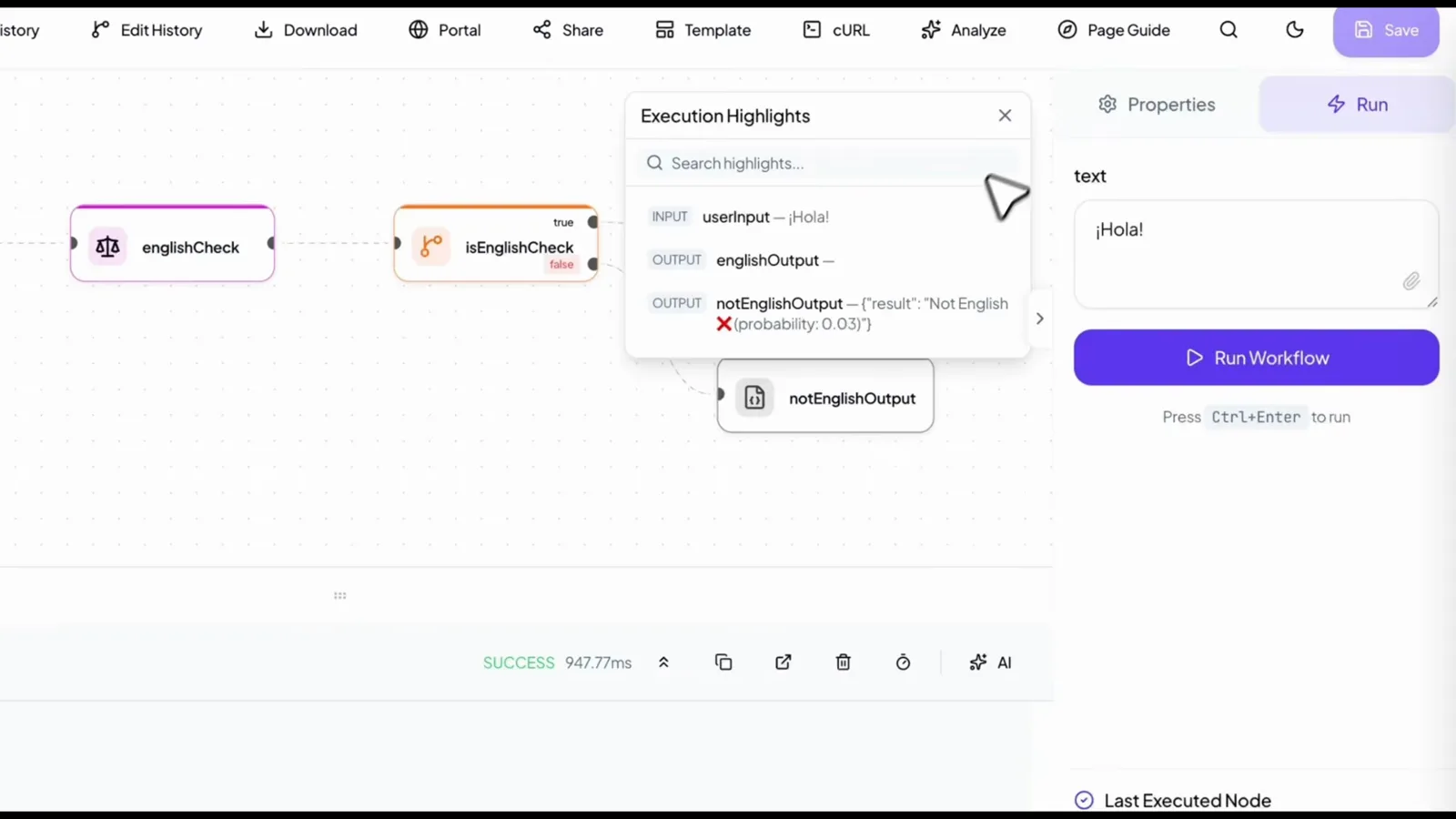
The completed run follows the non-English branch in this example.Watch at 1:34 - 4
Compare the English result before choosing a workflow branch
A later run uses “hi” and shows an English result with probability 0.98 in the execution highlights. The Noul question feeds an `isEnglishCheck` condition, which connects to separate English and non-English outputs. This single result is not a measured accuracy rate; evaluate representative labeled examples and decide what should happen when evidence is weak.
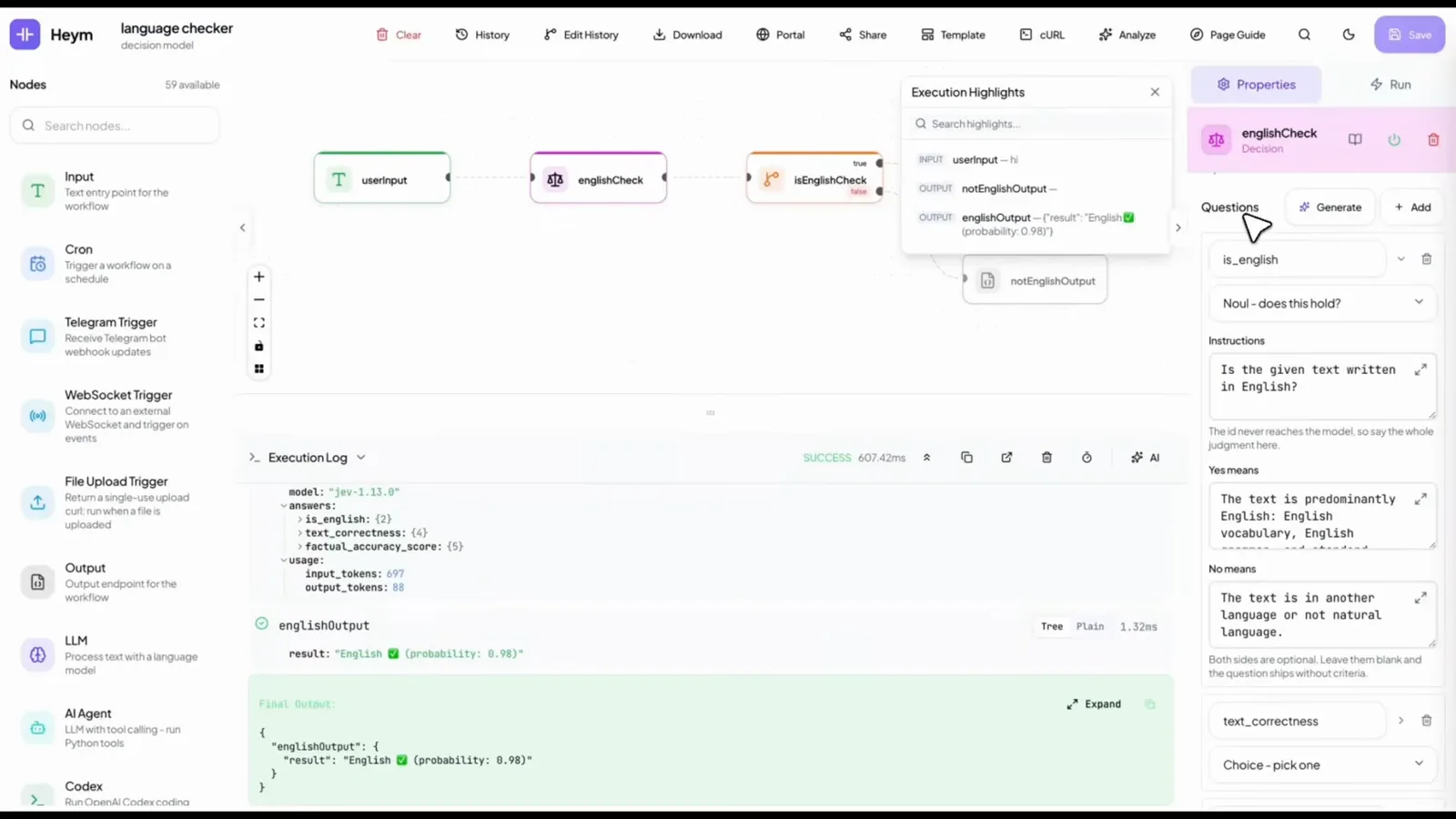
Compare both sides of the condition and test ambiguous inputs separately.Watch at 1:45 - 5
Audit runtime model choices in the execution trace
The orchestrator trace records separate routing turns for a fast task and a creative task, followed by their downstream calls. Inspect which decision selected each model and where it occurred in the workflow. The displayed durations and token count belong to this sample run; measure your own tasks before drawing performance or cost conclusions.
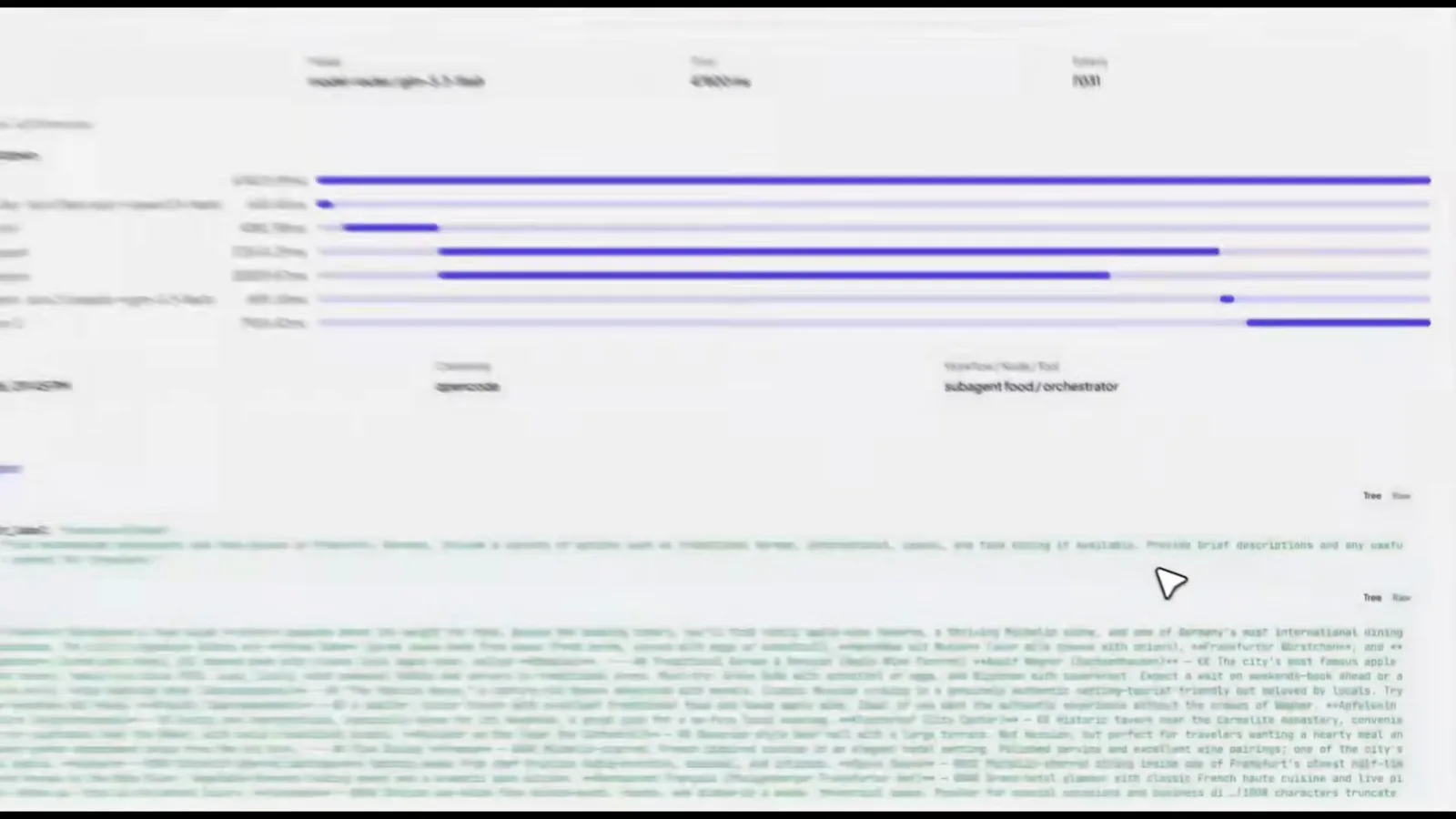
Trace rows help explain which model was selected at each runtime decision point.Watch at 2:08
Frequently asked questions
Can I use Jev to route models inside a Heym workflow?
The video demonstrates a Heym decision model selecting different configured models for different task types. Your workflow still needs clear routing criteria, credentials, and a tested fallback path.
Does the configured fallback guarantee that every failed route recovers?
No universal guarantee is established by the walkthrough. It shows a model option marked for routing failures. Test provider outages, invalid credentials, timeouts, and the resulting workflow state in the Heym version you deploy.
Does the 0.98 language result prove the workflow is 98% accurate?
No. It is the probability shown for one example input in the video, not a measured accuracy rate. Evaluate representative labeled examples and define what happens when evidence is weak or the input is ambiguous.
How is this different from a general Jev model-router guide?
This page follows the Heym interface, its Decision node, and its execution trace. The general model-router guide covers platform-independent routing design and trade-offs.
Related guides
Jev Model Router: Local and Cloud Model Routing
Compare platform-independent routing criteria and local-versus-cloud model choices.
ReadJev Model: Choice, Score, and Noul
Choose the typed output that fits a route, category, score, or yes/no gate.
ReadJev API Examples: curl, Python, and JavaScript
Review typed question payloads and responses outside the Heym interface.
ReadJev Log Triage with Expanso Edge
See selective Jev decisions used to route operational log events.
ReadJev Lead Enrichment with Treg
Compare another workflow that uses typed Jev decisions for lead categories.
ReadMore video walkthroughs
- Jev Classification Quickstart: OpenRouter API, Primitives & Real Probabilities
- Jev Architecture Explained: Why 70ms Decision Models Beat LLMs for Workflow Automation
- Ultra-Fast Browser Agents with Jev: 178ms DOM Loops & Dual Model Orchestration
- Open Jev Models Are Here: Semif, Nimble, Decider, DiffusionGemma & Laya Hands-On
- Jev vs LLM: Will Jev Replace LLMs? Krish Naik's Whiteboard Explainer
- Jev Trader Tutorial: Build a Subsecond AI Trading Bot on Monad
- Jev Model Router: Build a Privacy-Gated LLM Router with Jev & OpenJev
- Jev Tutorial for Beginners: State, Questions & the TypeScript SDK
- Run Jev Locally: Kev, SemIf & Von on Your Own GPU (OpenJev Guide)
- Jev RAG Reranker: Policy-Steered Reranking for Retrieval-Augmented Generation
- When to Use Jev: An Engineer's Audit of Claims, Gates, and Failure Modes
- LangChain + Jev Integration Tutorial: Routing, Guardrails & Evals
- Jev MCP Server: Connect Jev Decisions to Claude Code & Cursor
- Jev vs Luna: Independent Benchmarks Put "Better, Faster, Cheaper" to the Test
- Jev Agent Harness: Where the Decision Gate Sits in Your LLM Loop
- Jev Playground Walkthrough: The Hotdog Lesson, Criteria, and a Four-Console Token Test
- Jev Text Classification API: Zero-Shot CLI & REST with classifier.dev
- Jev API Examples: First Request, curl & All Three Question Types
- Jev Log Triage with Expanso Edge
- Jev Lead Enrichment with Treg: ICP and Signup Scoring