
Guides / illustrated walkthrough
Jev Playground Walkthrough: The Hotdog Lesson, Criteria, and a Four-Console Token Test
Caffeinated Software walks the TypeSafe playground end to end: the hotdog-sandwich lesson at 61% then 76% with criteria, a cube-rule Choice question ranking Taco at 94%, and the same prompt billed against GPT-5.6 Luna, Sonnet 5, and Gemini 3.7 Flash.
Quick takeaway
One screen recording, the whole playground loop — a complete step-by-step playground tutorial. The TypeSafe console’s hotdog-sandwich Noul lesson first answers 61% true; two sentences of true/false criteria push it to 76%; a rebuilt Choice question — a hotdog state plus eight cube-rule criteria — ranks Taco 94% (Sushi 5%, confidence 93%) in roughly 95 ms for 543 input tokens and 84 output tokens that Jev bills at zero. The identical prompt pasted into three rival playgrounds: GPT-5.6 Luna took 4.1s and billed 132 output tokens (445 in), Sonnet 5 answered taco with confidence 88 for 674 in → 173 out at about $0.0031 a run, and Gemini 3.7 Flash burned 495 in / 100 out while returning confidence 100. Every rival charges for output tokens and invents its own confidence number — that gap is the entire pitch.
Video source
Caffeinated Software
Step-by-step walkthrough
- 1
Get into the console and meet the three primitives
Access first: at recording, Jev was invite-only — you join a waitlist with your email plus what the presenter calls “the longest questionnaire of my life,” and his invite landed a few hours later (the project Discord keeps you sane while you wait). The launch pitch he cites: a new model from one of the ChatGPT co-inventors claiming 20–200× faster and 40–400× cheaper, because output tokens are free. Inside the console, the Playground’s “Select primitive type” panel is the whole vocabulary: Noul — evaluate how true something is (a value from 0 to 1), Score — set up a rubric to grade with, Choice — ask a multiple choice question, each with Docs links. The Learn to TypeSafe panel packages the same ideas as walkthrough lessons — Is hotdog a sandwich? (Noul), What color is the sky? (Choice), Can monkeys create art? (Score) — above real-life use cases: résumé screening, support agent audit, helpdesk ticket triage. The model selector at the bottom reads jev-latest.
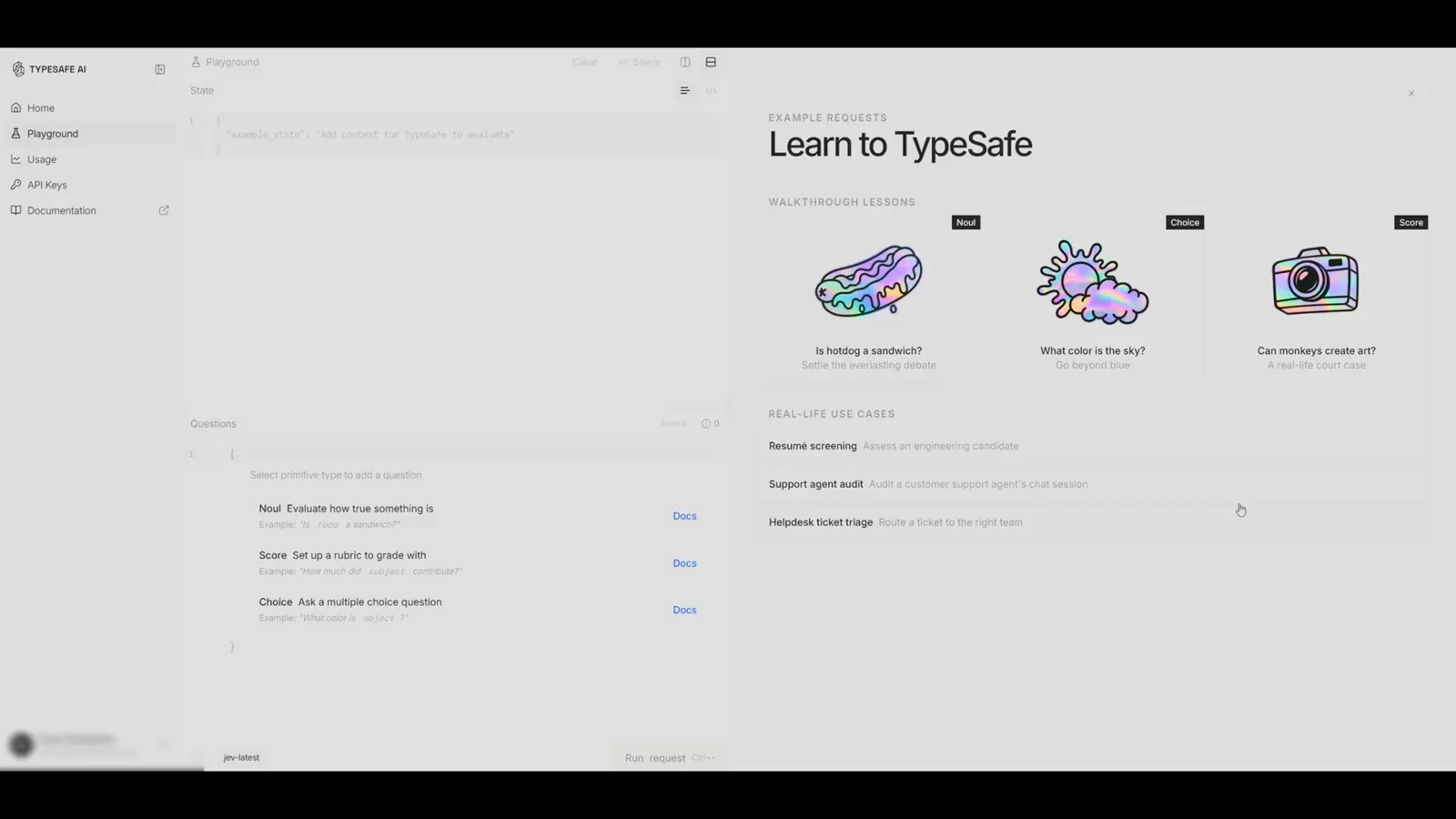
The console doubles as a classroom: three primitives, three lessons.Watch at 1:25 - 2
Run the starter Noul question — and get an honest 61%
The hotdog lesson opens a two-panel editor. State holds a placeholder — { "example_state": "Add context for TypeSafe to evaluate" } — and Questions holds one Noul question: { "is_sandwich": { "type": "noul", "instructions": "Is hotdog a sandwich?" } }. Hit Run request (Ctrl+Enter) and the Response panel answers 61% true, stamped jev-latest 100ms · 118ms. The lesson’s own coach mark does the teaching: “Hmm, the model’s rather unsure. Let’s clarify what a sandwich is in our question.” A bare question gets a shrug — that uncertainty is the setup for the next step, not a defect.
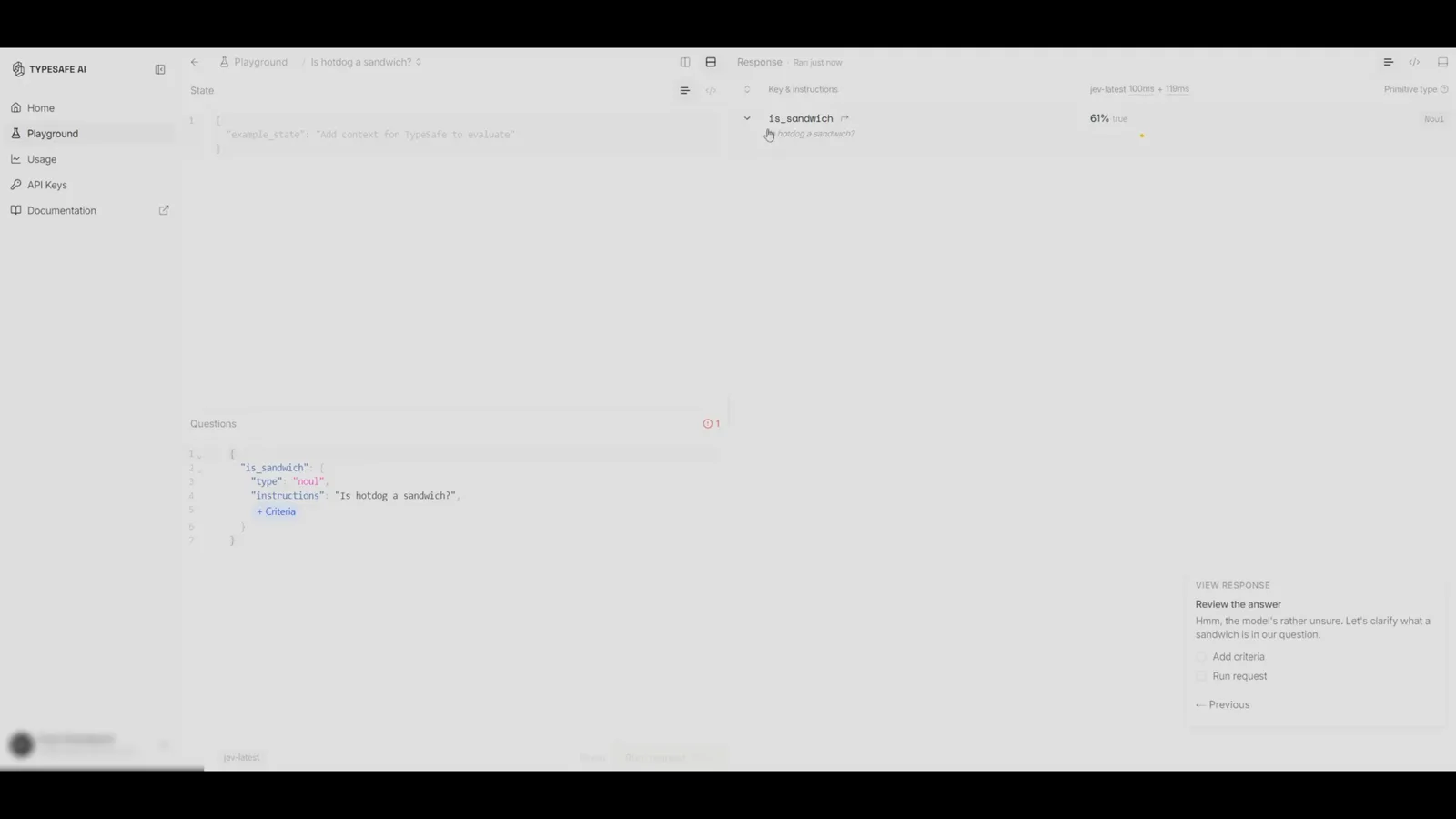
First run: 61% true — the lesson itself calls the model unsure.Watch at 2:12 - 3
Add criteria and watch 61% become 76%
Criteria are definitions attached to a question — in the presenter’s words, “basically a definition.” The lesson adds two: true = “A sandwich is a food dish where a filling, such as meat, cheese, vegetables, or spread, is placed between structural starch”; false = “The food has no bread enclosing a filling or uses only a single slice of bread, or uses a non-bread wrapper such as a tortilla, wafer, or cookie.” Re-run the identical question and the answer moves to 76% true (jev-latest 135ms · 124ms). Same state, same instruction text — the definition alone recalibrated the judgment. That is the whole calibration loop: when Jev is unsure, describe the boundary.
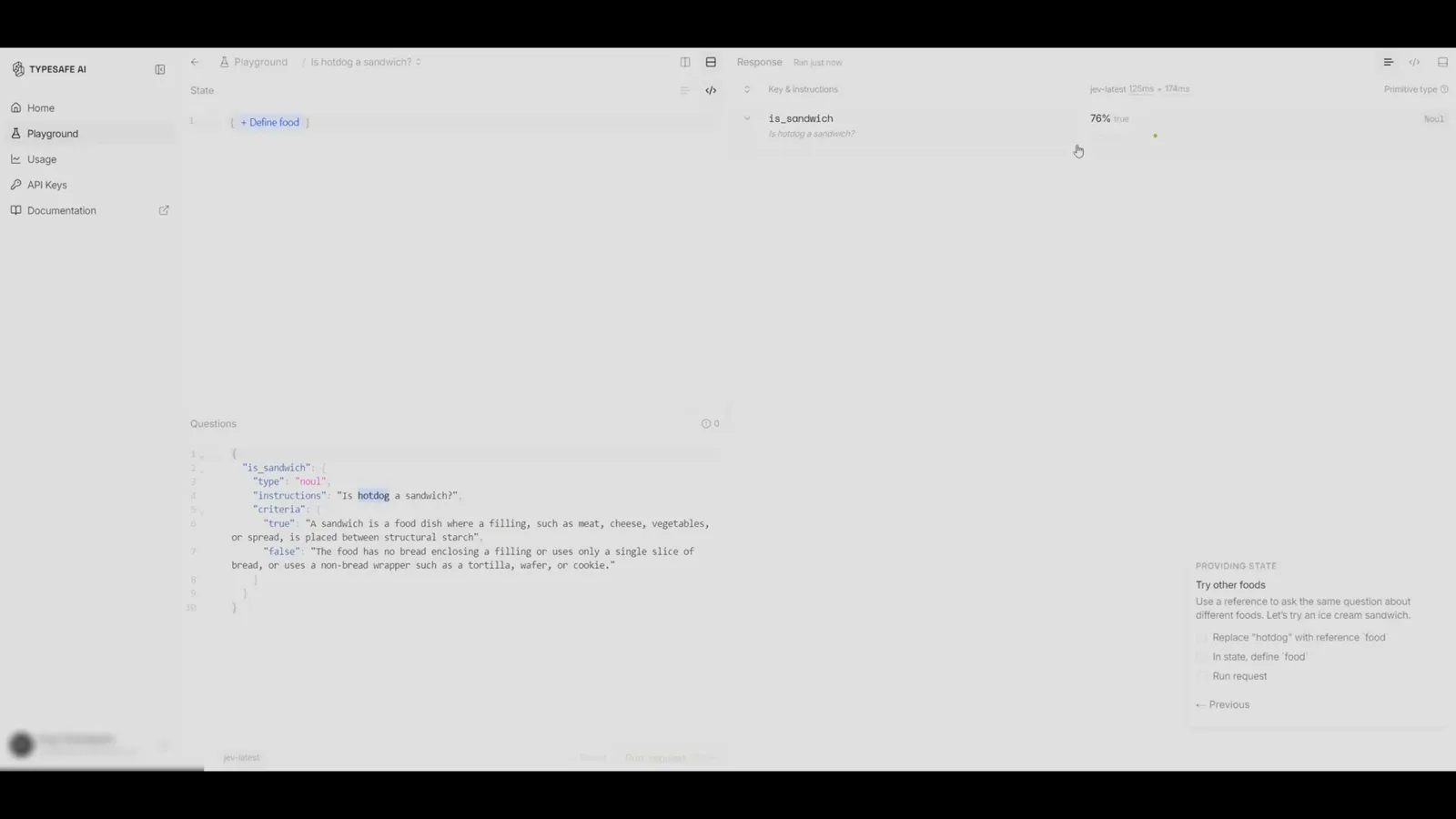
Two sentences of definition move the verdict to 76%.Watch at 2:26 - 4
Build the real question: a state, a Choice, and the cube rule
The presenter’s friend looked at the 76% sandwich screenshot and countered: it’s a taco. So he rebuilt the question from scratch. The State now defines the subject: { "hotdog": "A food with a starch on 3 sides and a cylindrical meat filling." } (he notes you can throw random scenarios in here too). The question becomes a Choice — instructions “What is a hotdog?” — whose criteria encode all eight options from the cube food chart: Cake (starch as structural horizontal layers), Calzone (starch on all 6 sides, fully enclosed), Quiche (starch on 5 sides, a vessel), Taco (starch on 3 sides — bottom plus two walls, open top and ends), Salad (starch on 0 sides), Toast (starch on 1 side, open-faced), Sandwhich (starch on 2 opposite sides), Sushi (starch on 4 sides, wraps around, carb as a tube). Describing every option is what makes the answer checkable.
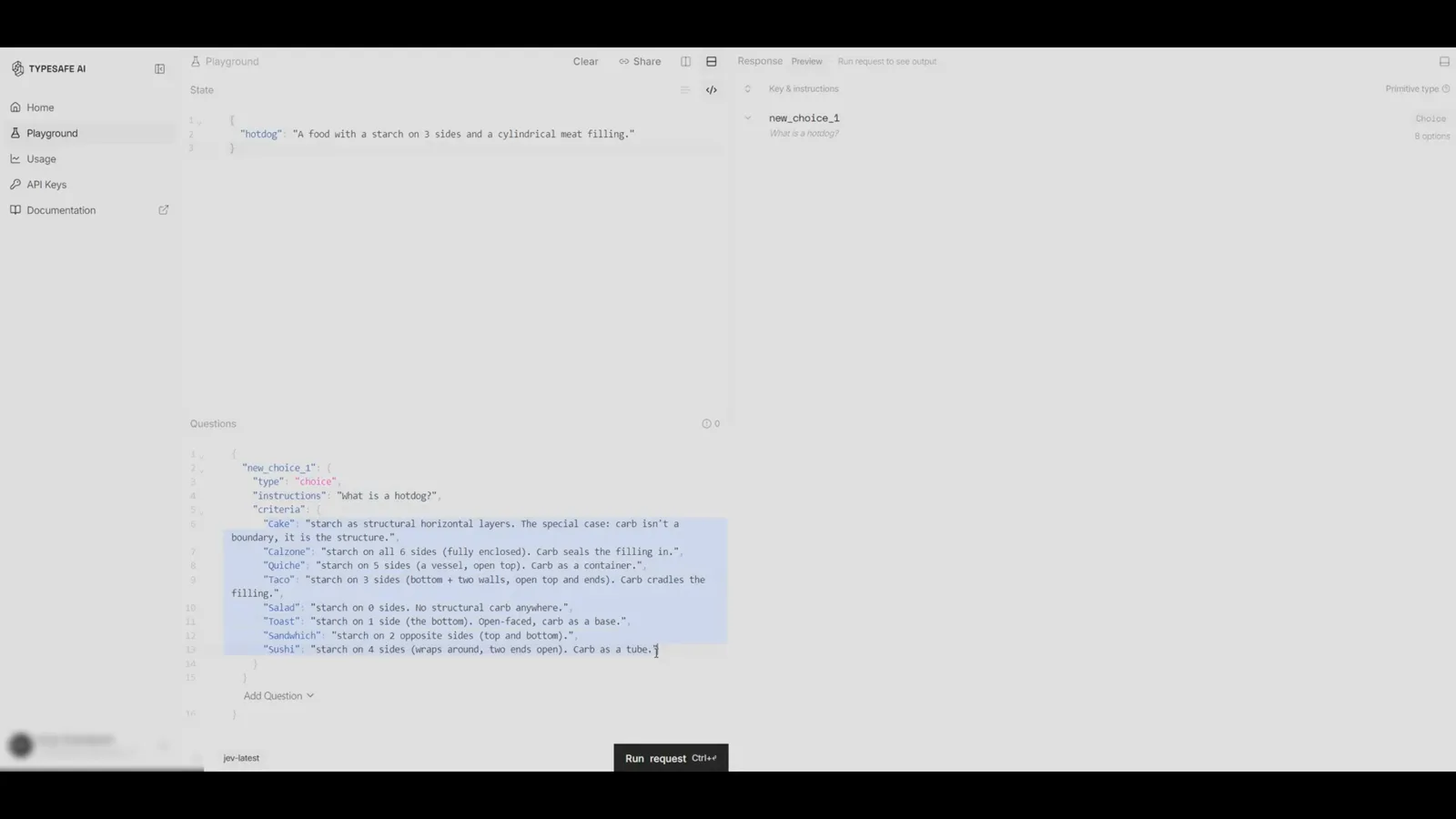
The state says what a hotdog is; the criteria encode the cube rule.Watch at 3:24 - 5
Run it: every option ranked, plus a confidence rating
The response panel ranks all eight options instead of muttering prose: Taco 94%, Sushi 5%, Sandwhich 1%, with Cake, Toast, Salad, Calzone, and Quiche at 0% — and “Confidence: 93%” underneath (jev-latest 95ms + 186ms on this run). “And this is what makes it different from an LLM,” the presenter says — “it just gives a solid format.” Re-runs wobble by a point or two: his comparison run later quotes 96% taco. The ranked list is the point — you can branch on any cutoff, not just the winner.
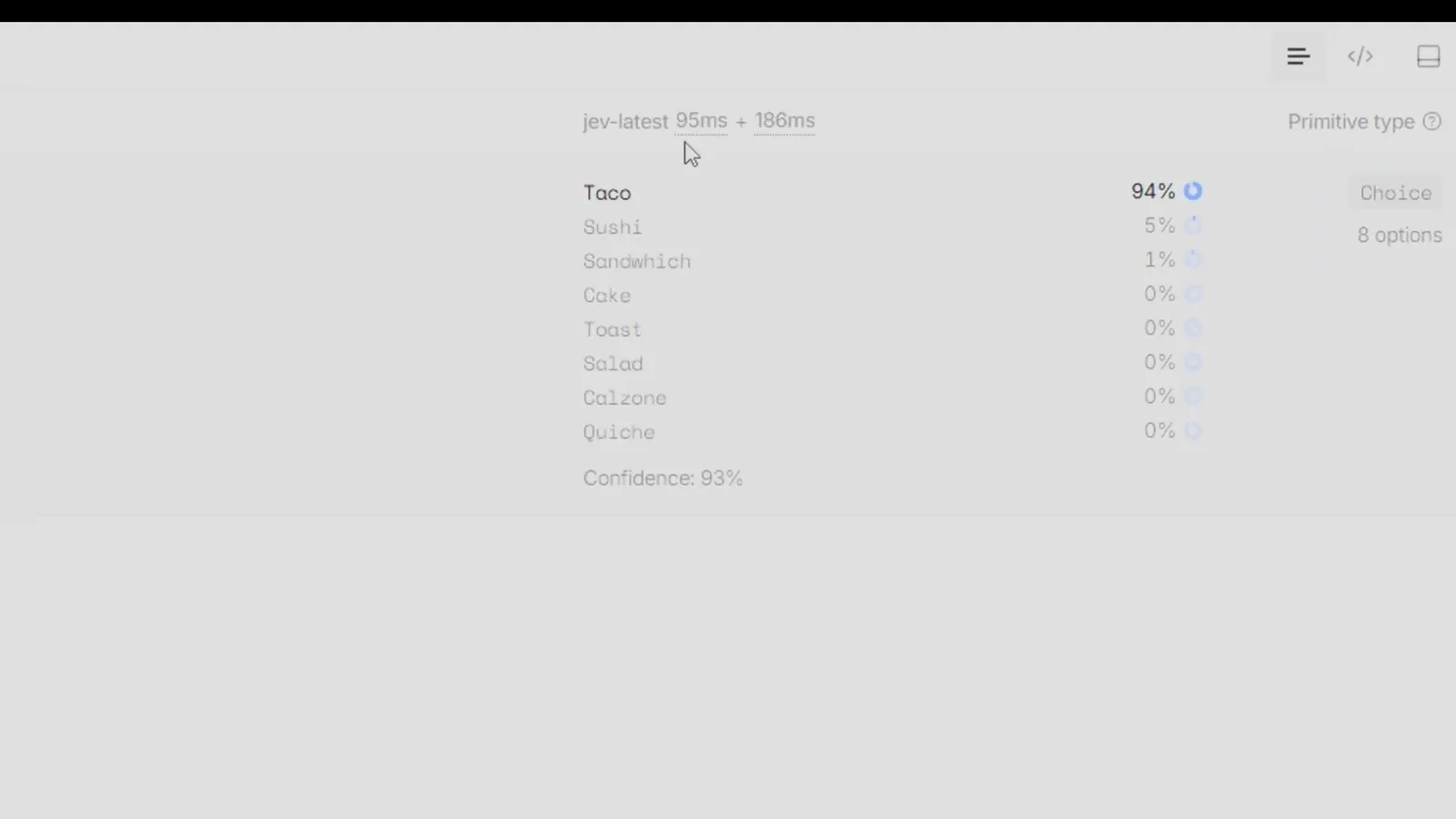
All eight options ranked, one overall confidence.Watch at 4:12 - 6
Open the JSON: 543 tokens in, 84 out — and output is free
Toggle the JSON view and the run decomposes cleanly: "choice": "Taco", "confidence": 0.93, a "probabilities" object covering all eight options, then "usage": { "input_tokens": 543, "output_tokens": 84 }, "request_id": "playground_…", "evaluation_time_ms": 95.42. The token counts print the same every run, the presenter notes — and the economics are the pitch: “Jev does not charge you for the output tokens, which in this case would have only been 84.” About 95 milliseconds of evaluation for the whole verdict.
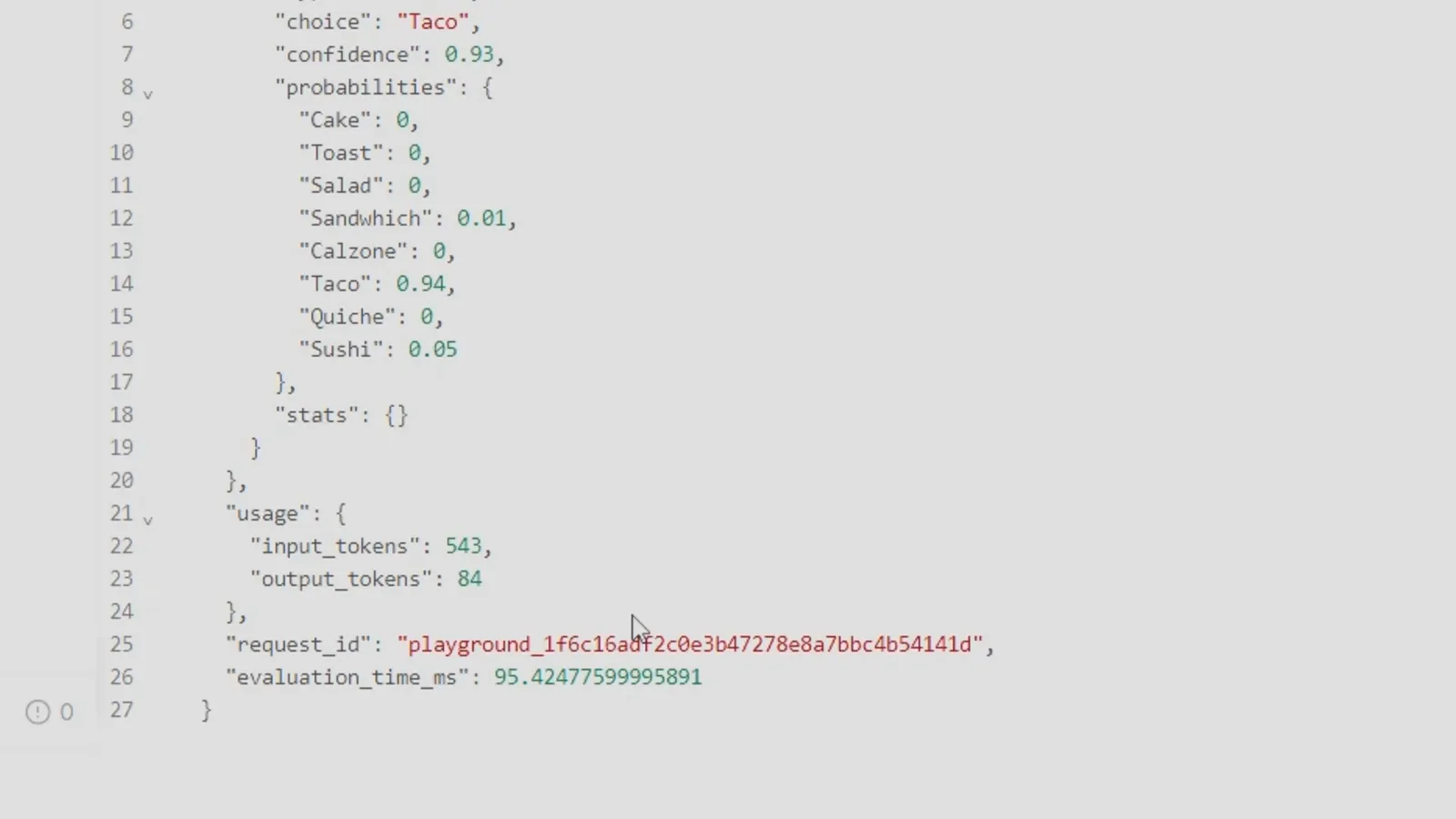
543 tokens in, 84 out — and the out is free.Watch at 4:20 - 7
Clone the prompt into three rival playgrounds
For the speed test he tiles four playgrounds on one screen — TypeSafe top left, OpenAI top right, Claude Console lower left, Google AI Studio lower right — and pastes the exact same prompt into each (“no extra spaces,” he warns; the prompt sits on screen to pause-and-copy). The OpenAI Configure panel shows its shape: evaluate the state against every option’s criteria, probabilities across all options MUST sum to 100, then report the single most likely option plus a separate confidence (0–100). The models are “the default, freeish ones”: GPT-5.6 Luna, Sonnet 5 (the claude-sonnet-5 dropdown), and Gemini 3.7 Flash, which gets a “You are a classification engine, not a chatbot” system instruction. Jev runs first: “we already see how fast it is — 96% taco.”
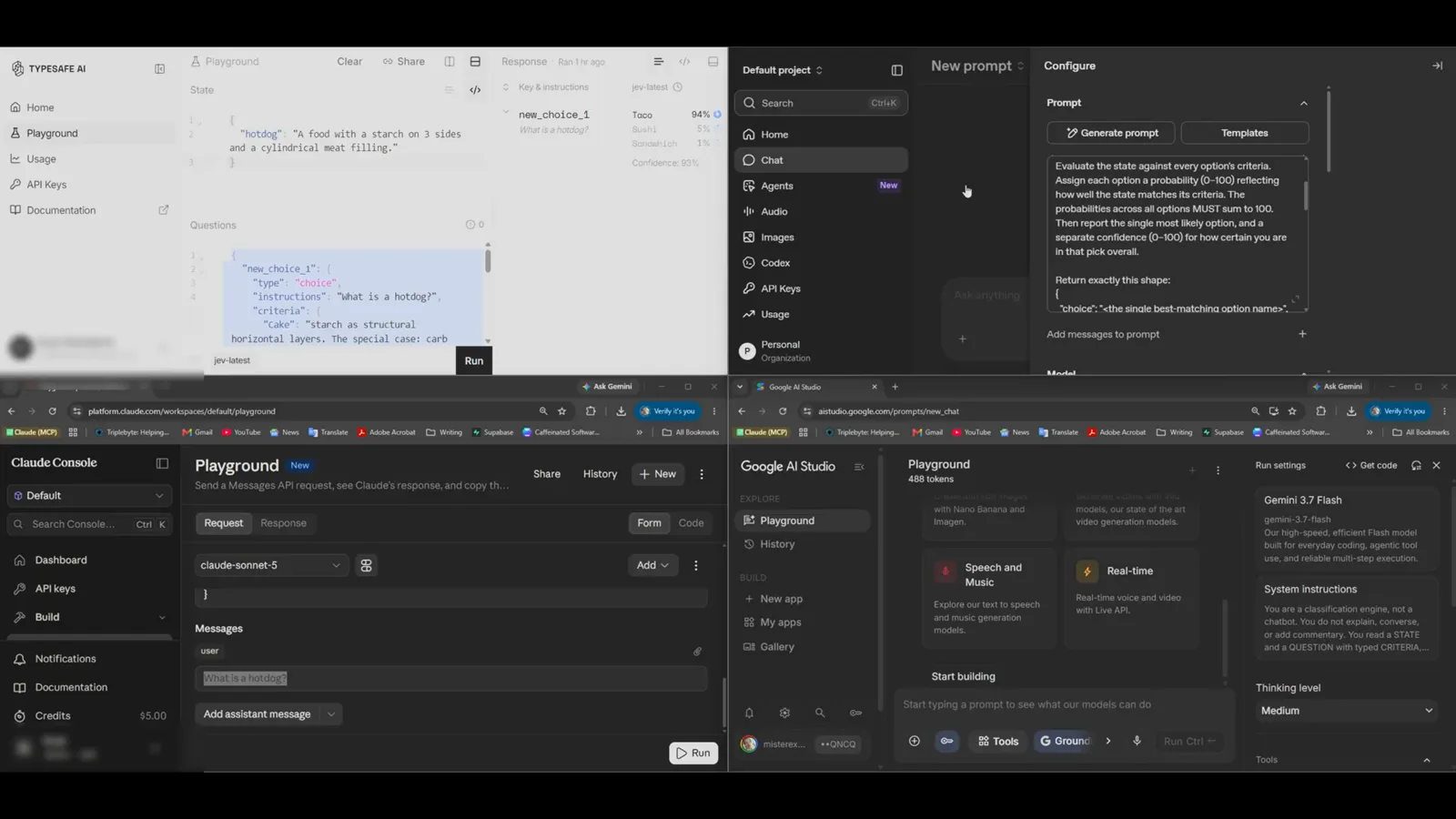
One prompt, four consoles, not a single extra space.Watch at 5:52 - 8
The verdict: what the same decision costs elsewhere
GPT-5.6 Luna thinks in chain-of-thought for 4.1 seconds and spends roughly 577 tokens (445 in + 132 out) — the 132 output tokens are billed, and its probabilities are, in his words, made up. Sonnet 5 in the Claude Console also says Taco with confidence 88: the workbench footer reads ≈ $0.0031 for 674 in → 173 out — about a third of a penny — with the wall clock at 6.1s. Gemini 3.7 Flash answers quickest of the three (~3 seconds by his read) yet burns 495 input + 100 output tokens (595 total) and returns “Taco” at a suspiciously perfect confidence 100. Jev’s comparable run: 543 in, 84 out, nothing charged for the output, verdict and ranked probabilities in about 95 ms. The scale argument: a business making millions of these decisions a day feels every one of those output tokens.
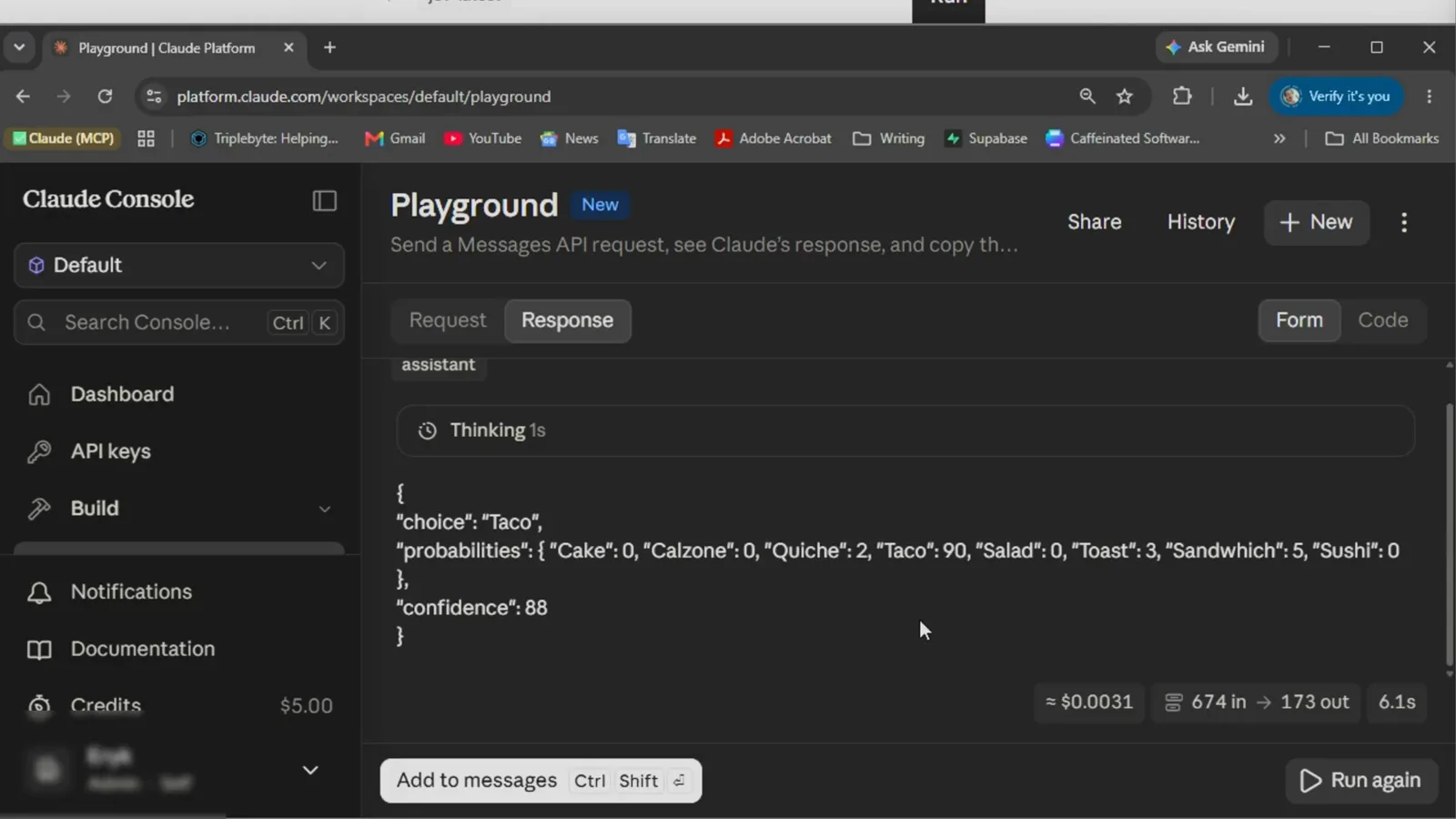
Sonnet 5’s taco verdict: about a third of a cent.Watch at 7:00
Frequently asked questions
Can you try the Jev playground without writing any code?
Yes — that is the point of the video. The TypeSafe console playground runs entirely on panels: pick a primitive (Noul, Score, or Choice), edit the State and Questions JSON, click Run request (Ctrl+Enter), and read ranked answers with a confidence rating. No SDK, no curl — the presenter completes the whole hotdog-sandwich exercise, including the JSON usage view, without opening a code editor.
How do you get access to the TypeSafe console?
At recording time Jev was invite-only: submit your email on the Join Our Waitlist form, answer a long questionnaire, and wait — the presenter’s invite arrived a few hours later. He also recommends the project’s Discord while you wait. Once in, the Playground section hosts the walkthrough lessons and the free-form editor used throughout this guide.
What is the difference between Noul, Choice, and Score?
They are the three question primitives the playground exposes. Noul evaluates how true something is on a 0–1 scale (the hotdog-sandwich lesson). Choice picks from a list you define (the eight-way hotdog classification). Score applies a rubric to grade with — the third lesson, Can monkeys create art?, uses it. The type you pick fixes the shape of the answer that comes back.
Is Jev actually cheaper than ChatGPT or Claude for classification?
For this exact task, the video’s receipts say yes. Jev: 543 input tokens, 84 output tokens — and output tokens are free. GPT-5.6 Luna: 445 in + 132 billed out, 4.1 seconds. Sonnet 5 in the Claude Console: 674 in → 173 out at about $0.0031 per run (a third of a cent). Gemini 3.7 Flash: 495 in + 100 out. Per decision the gap is pennies; at millions of decisions a day, the presenter argues, it becomes a budget line.
Why did the hotdog answer change from 61% to 76%, and 94% to 96%?
Two different effects. The 61% → 76% jump is calibration: adding true/false criteria gave the model definitions to judge against. The 94% vs 96% taco wobble is run-to-run variance — the presenter re-ran the same question a few times and watched the top probability move by a point or two before settling, which is why he reads the ranked list and confidence rather than trusting a single winner.
Related guides
Jev Playground (interactive)
Run the same state-plus-questions workflow against live Jev models right on this site — no console signup.
ReadJev Getting Started Guide
The SDK route: once the playground proves the decision, wire it into code.
ReadJev Schema Builder
Design MECE options and behavioral criteria before you open the console — the cube-rule criteria here are the pattern.
ReadJev API Reference
The evaluate endpoint and typed payload behind every playground run.
ReadWhen to Use Jev Guide
Where a decision model beats an LLM — and where it does not.
ReadMore video walkthroughs
- Jev Classification Quickstart: OpenRouter API, Primitives & Real Probabilities
- Jev Architecture Explained: Why 70ms Decision Models Beat LLMs for Workflow Automation
- Ultra-Fast Browser Agents with Jev: 178ms DOM Loops & Dual Model Orchestration
- Open Jev Models Are Here: Semif, Nimble, Decider, DiffusionGemma & Laya Hands-On
- Jev vs LLM: Will Jev Replace LLMs? Krish Naik's Whiteboard Explainer
- Jev Trader Tutorial: Build a Subsecond AI Trading Bot on Monad
- Jev Model Router: Build a Privacy-Gated LLM Router with Jev & OpenJev
- Jev Tutorial for Beginners: State, Questions & the TypeScript SDK
- Run Jev Locally: Kev, SemIf & Von on Your Own GPU (OpenJev Guide)
- Jev RAG Reranker: Policy-Steered Reranking for Retrieval-Augmented Generation
- When to Use Jev: An Engineer's Audit of Claims, Gates, and Failure Modes
- LangChain + Jev Integration Tutorial: Routing, Guardrails & Evals
- Jev MCP Server: Connect Jev Decisions to Claude Code & Cursor
- Jev vs Luna: Independent Benchmarks Put "Better, Faster, Cheaper" to the Test
- Jev Agent Harness: Where the Decision Gate Sits in Your LLM Loop
- Jev Text Classification API: Zero-Shot CLI & REST with classifier.dev
- Jev API Examples: First Request, curl & All Three Question Types