
Guides / illustrated walkthrough
Jev as an LLM Judge: Confidence-Gated Cascades at 0.36% of the Cost
A whiteboard-by-whiteboard guide to Agent Engineering’s 11-minute deep dive on Jev as a judge: judge biases, calibration, the Carnegie Mellon study of Jev 1.13 vs 16 judges, and the confidence cascade that keeps 99% of GPT-6 accuracy at 57% of its fee.
Quick takeaway
Agent Engineering’s 11-minute whiteboard deep dive covers LLM-as-a-judge from the ground up and then hands you the paper’s cascade recipe. Judge basics: pairwise preference (which of two answers is better) and single-answer grading (supported vs hallucinated, correct vs incorrect) both suffer position bias, verbosity/style bias, and self-preference — and a reasoning judge writes tokens for every verdict, so trust and price are both engineering problems. The news is a Carnegie Mellon study (Li, Miao, Krishnan & Padman) that tested Jev 1.13 as a judge against 16 others — GPT models up to GPT-6 Astra, Claude Sonnet 5, Gemini, Qwen, and two reward models — on RewardBench (ordinary preference, 400 items), JudgeBench (hard correctness, 350), HaloEval (evidence-grounded factuality, 240), and RM-Bench (style-rewritten pairs), with thresholds fitted on a 40% selection split, frozen, and tested on the 60% held-out slice. Where it holds up: RewardBench 92.2 vs GPT-6’s 93.5, HaloEval 87.5 vs 86.7, final-answer checking within 3.2 points — at $0.044 versus $12.18 per 1,000 judgments, 0.36% of the price, with median latency of 0.15 s versus 1.89 s. Where it breaks: JudgeBench hard correctness 78.6 vs 93.1 (reasoning 68 vs 96, coding 76 vs 98), style-adversarial pairs 84.0 → 74.8 when the wrong answer is the elaborately written one, and four-way selections need validation first. The redeeming property is calibration: correct verdicts pile up at probability 1.0 while mistakes smear across 0.5–0.9; below 0.6 Jev is right only 47.7% of the time (a coin flip) but at full confidence it is right on 99.1% of 322 items (AUROC 0.83). That honesty powers the cascade: Jev judges every trace in both orders (averaging the aligned probability also cancels position effects), a frozen threshold of 0.9 accepts 53.7% of pairs outright, and everything else escalates to GPT-6 — 92.5 vs 93.1, keeping over 99% of the strong judge’s accuracy at 57% of its fee ($5.73 blended vs $12.18 per 1,000 in the video’s own arithmetic). The paper’s rule: fit the threshold on a selection split, freeze it before touching test data, and treat confidence as an escalation signal, not a certificate — the video’s closing line and the reason you measure calibration on your own traffic before trusting it.
Video source
Agent Engineering
Step-by-step walkthrough
- 1
Know the two judge formats — and their three biases
LLM-as-a-judge means handing a capable model a rubric and asking it to grade another model’s output. Pairwise preference shows the judge two answers to the same question and asks which is better; single-answer grading gives one answer (often with evidence or a reference) and a label like supported/hallucinated or correct/incorrect. Both formats inherit failure modes: position bias (favoring whichever answer comes first), verbosity or style bias (rewarding longer, more polished answers), and self-preference for the judge’s own model family. And at scale there is cost: a reasoning judge writes tokens for every single verdict.
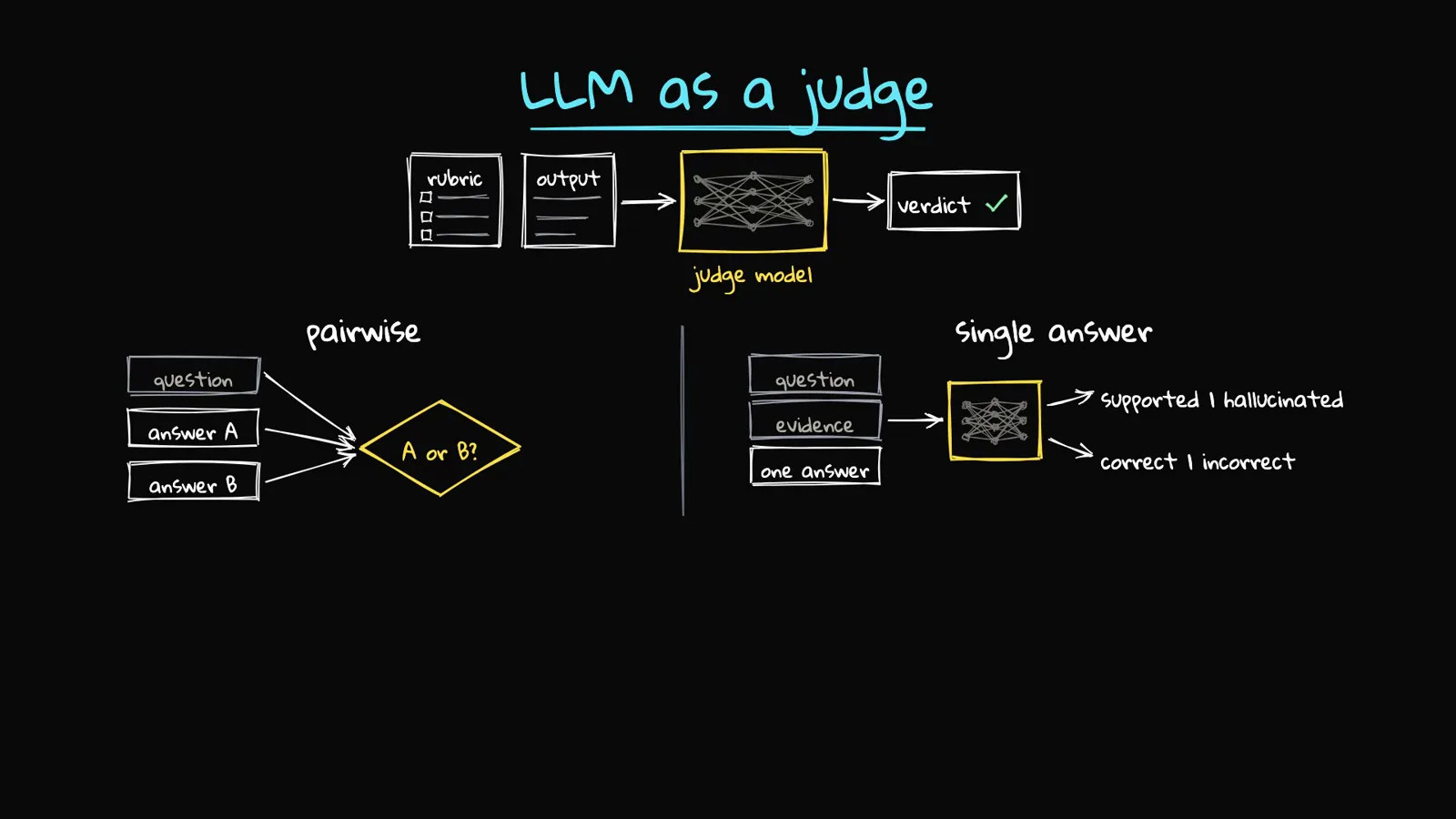
Two formats, three biases — plus a token bill for every verdict the judge writes.Watch at 1:02 - 2
The study: Jev 1.13 against 16 judges, thresholds frozen
A Carnegie Mellon team (Li, Miao, Krishnan & Padman) tested Jev 1.13 as a judge against 16 comparators — GPT models up to GPT-6 Astra, Qwen, Claude Sonnet 5, and the PairRM and SigLiom reward models. The workloads: RewardBench for ordinary preference (400 items), JudgeBench for hard correctness (350), HaloEval for evidence-grounded factuality (240), plus style-rewritten pairs on RM-Bench (140 hard). Methodology worth copying: where Jev and GPT-6 disagreed, a team member adjudicated 183 items blind; thresholds were fitted on a 40% selection split, then frozen and scored on the 60% held-out test set — exactly how you should do it too.
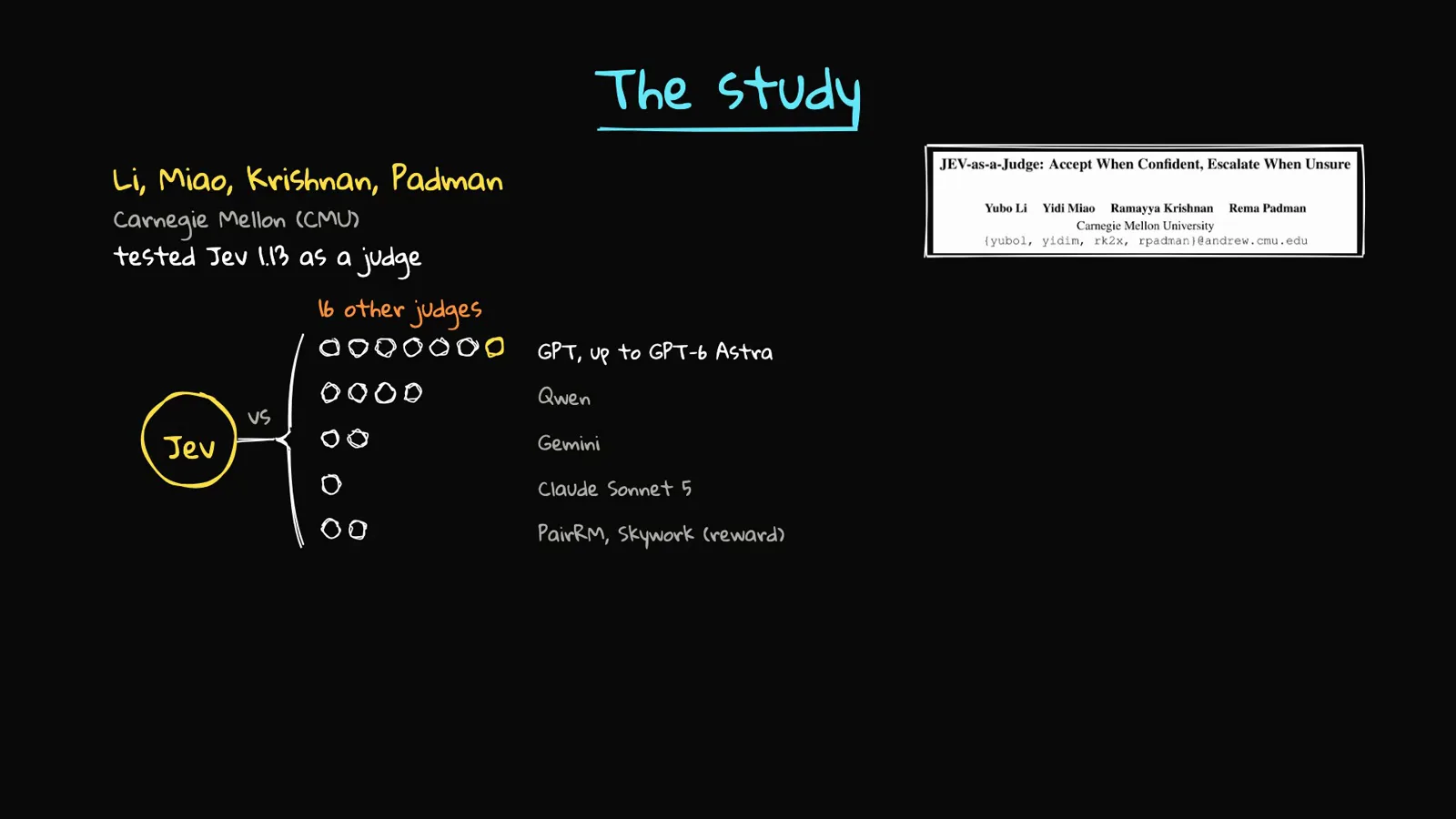
Sixteen judges, four workloads, and a frozen-threshold protocol you can steal.Watch at 2:43 - 3
Where it holds up: within 3 points at 0.36% of the price
Table two is the operating envelope. On ordinary preference (RewardBench), Jev scores 92.2 against GPT-6’s 93.5 — use Jev. On evidence-grounded factuality (HaloEval), 87.5 vs 86.7 — use Jev again. Final-answer adjudication lands within 3.2 points. The rows marked escalate are where Jev concedes: matched-style pairs 84.0 vs 97.3, style-adversarial 74.8 vs 94.6, four-way selections 75.8 vs 94.0, grounded summaries 71.2 vs 72.5. And the fee: about $0.044 per 1,000 judgments versus $12.18 for GPT-6 — 0.36% of the price. The blind human check leaned slightly toward GPT-6, but Jev stayed within about three points.
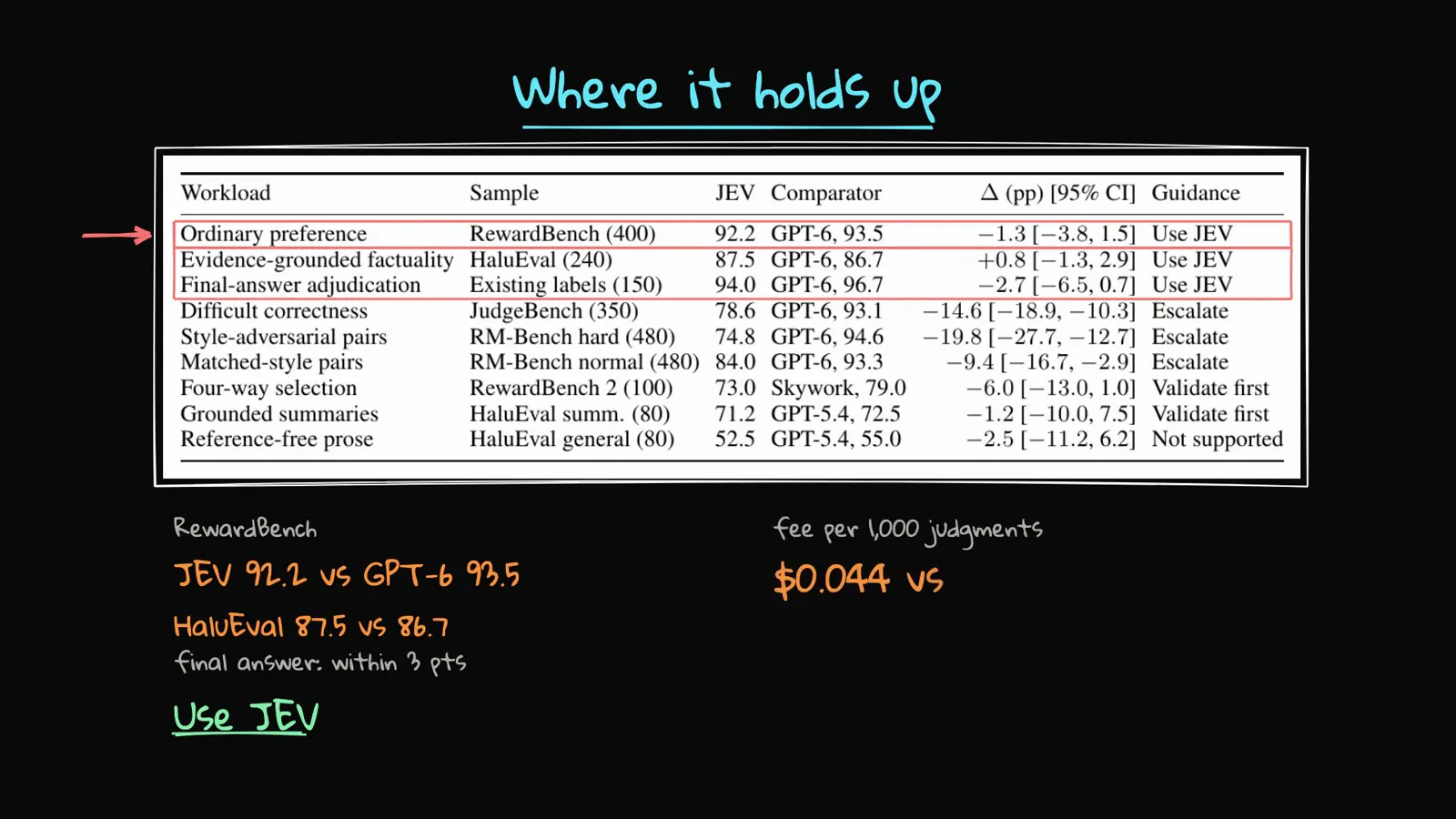
Ordinary preference and grounded factuality are Jev’s home turf; everything derivation-heavy escalates.Watch at 4:02 - 4
Where it breaks: derivations, code, and persuasive wrong answers
JudgeBench asks the judge to actually verify correctness, and that is where the gap opens: 78.6 vs 93.1 overall, with the by-domain split showing reasoning at 68 vs 96.1, coding 76 vs 98, knowledge 84.4 vs 93.8. The paper’s verdict: weakest wherever you must check a derivation. The blind human record confirms it is not label noise — on disputed items the annotator sided with GPT-6 57 times and with Jev once. The second weakness is style: when the wrong answer is the more elaborately written one, Jev falls from 84.0 to 74.8 while GPT-6 barely moves (97.3 to 94.6) — picking the better answer and resisting a persuasive wrong one are different skills.
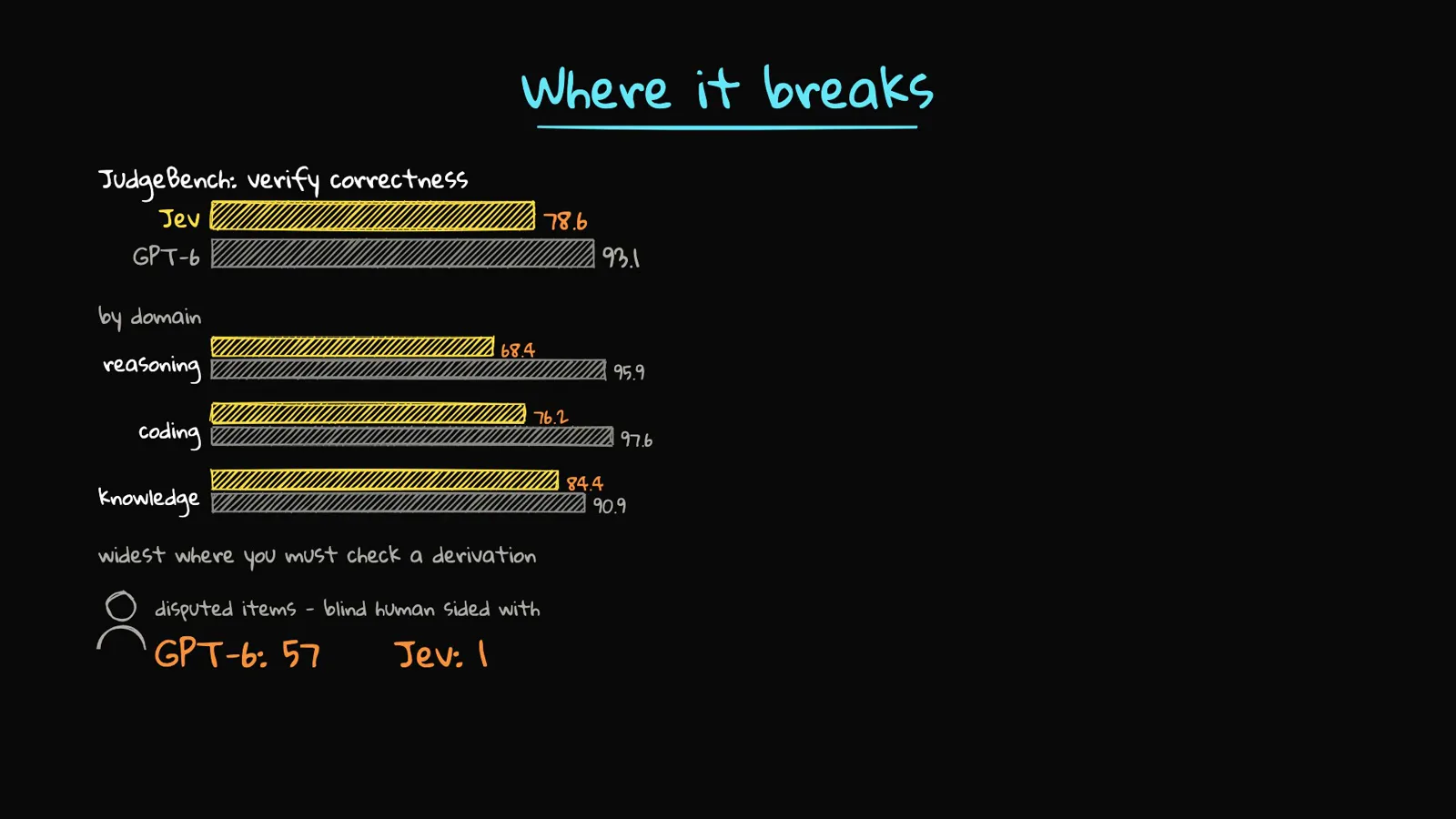
Verification is the wall: derivations and code go to the strong judge, not the cheap one.Watch at 4:40 - 5
Confidence orders the errors
Figure three is the property that saves the cheap judge. Across RewardBench, JudgeBench, and HaloEval, the teal bars (correct verdicts) pile up at maximum probability 1.0 while the red bars (mistakes) smear across 0.5–0.9. On HaloEval at confidence 0.9 or above, Jev made 10 errors in 199 verdicts while GPT-6 made 28 in 233. The histogram is the visual argument for everything that follows: Jev’s mistakes are concentrated where it is unsure, which is exactly where a gate can catch them.
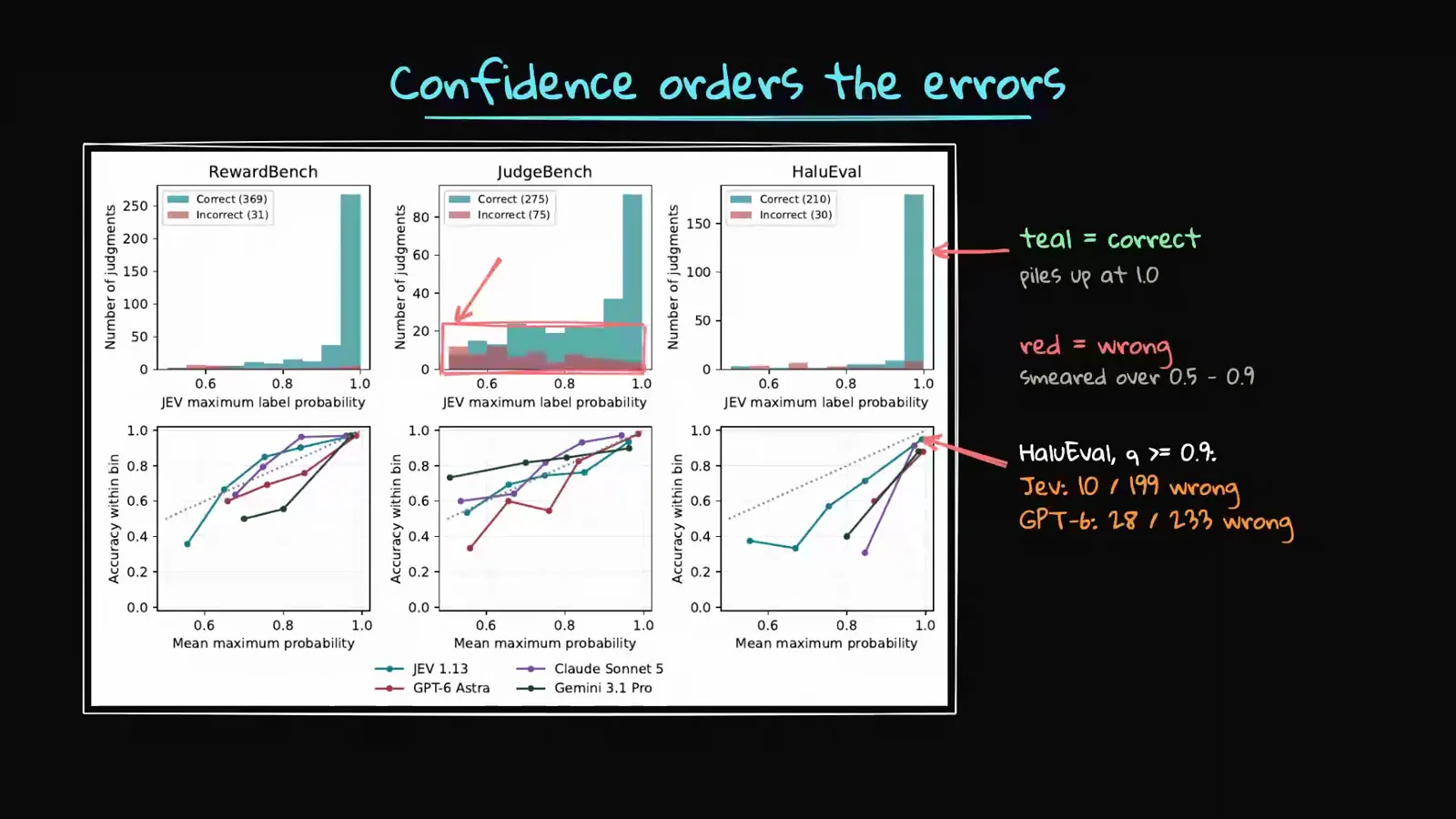
Wrong answers hide at low confidence — the raw material of an escalation policy.Watch at 6:02 - 6
Calibration, quantified: 47.7% below 0.6, 99.1% at full confidence
Pooling all 990 judgments binned by Jev’s confidence puts numbers on the honesty: below 0.6, Jev is right only 47.7% of the time — basically a coin flip. At full confidence it is right on 99.1% of 322 items, and GPT-6 on those same items only moves from 78.5 to 99.1 — its advantage lives where Jev is unsure (AUROC 0.83). On items Jev would accept at 0.9 the two judges are nearly interchangeable, 95.8 vs 96.5; on the escalate slice GPT-6 leads by 15 points — exactly where the expensive judge earns its fee.
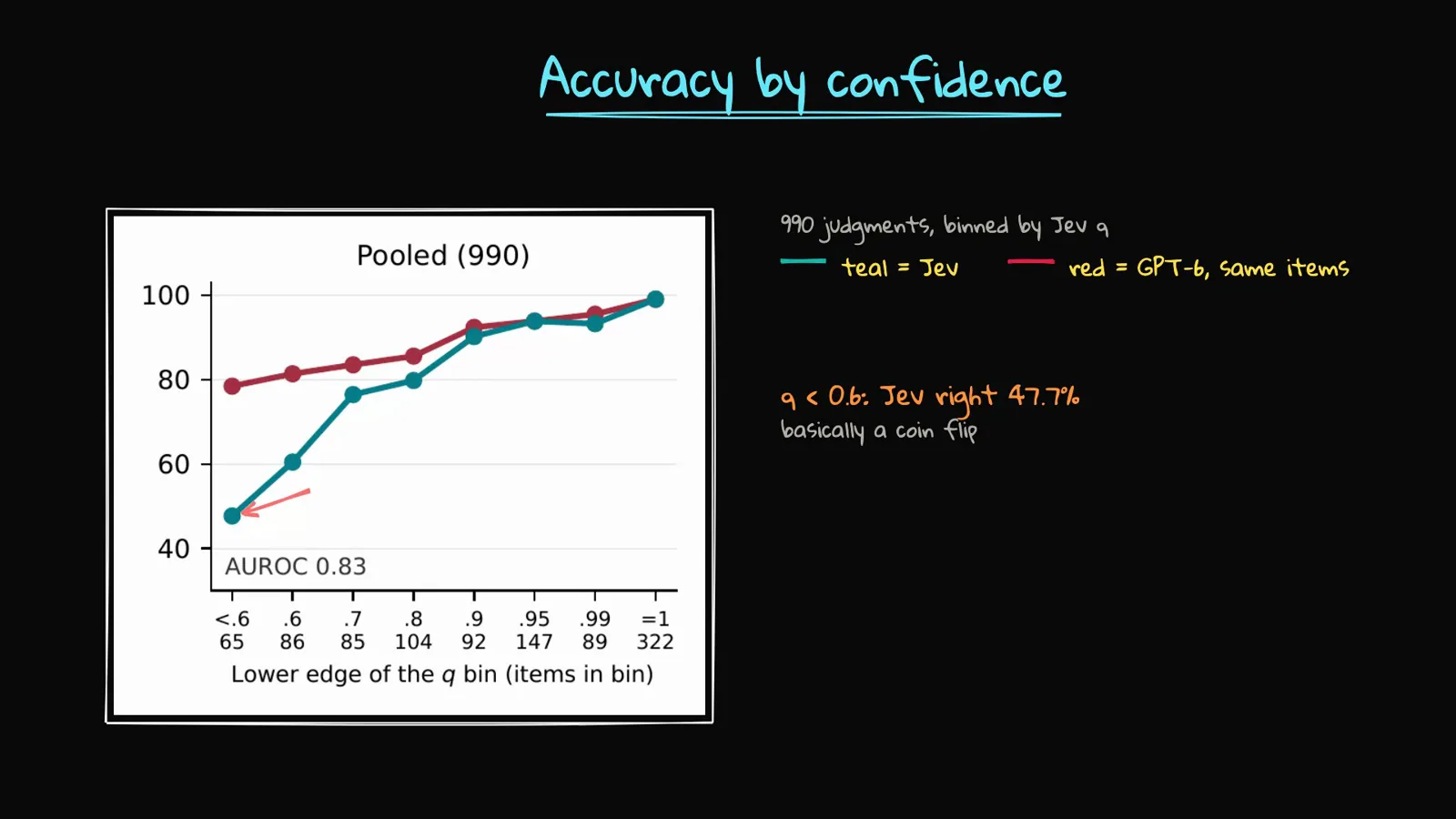
The cheap judge does not need to be right about everything — only honest about when it is unsure.Watch at 6:25 - 7
The cascade: Jev gates, GPT-6 arbitrates
Figure four assembles the system. Every production trace goes to Jev first — in both orders for pairwise work, because averaging the aligned probability p(A) = ½[p(A|A,B) + 1 − p(B|B,A)] also cancels position effects. The confidence q is compared against a frozen threshold tau: clear it, accept the verdict and pay almost nothing more; fall below, escalate to the strong judge whose decision becomes final. With GPT-6 as the fallback at tau 0.9, the cascade accepted 53.7% of 510 held-out pairs and scored 92.5 against 93.1 — over 99% of GPT-6’s accuracy at 57% of its fee. On RewardBench the cascade even beat GPT-6 alone, because the two judges make different mistakes.
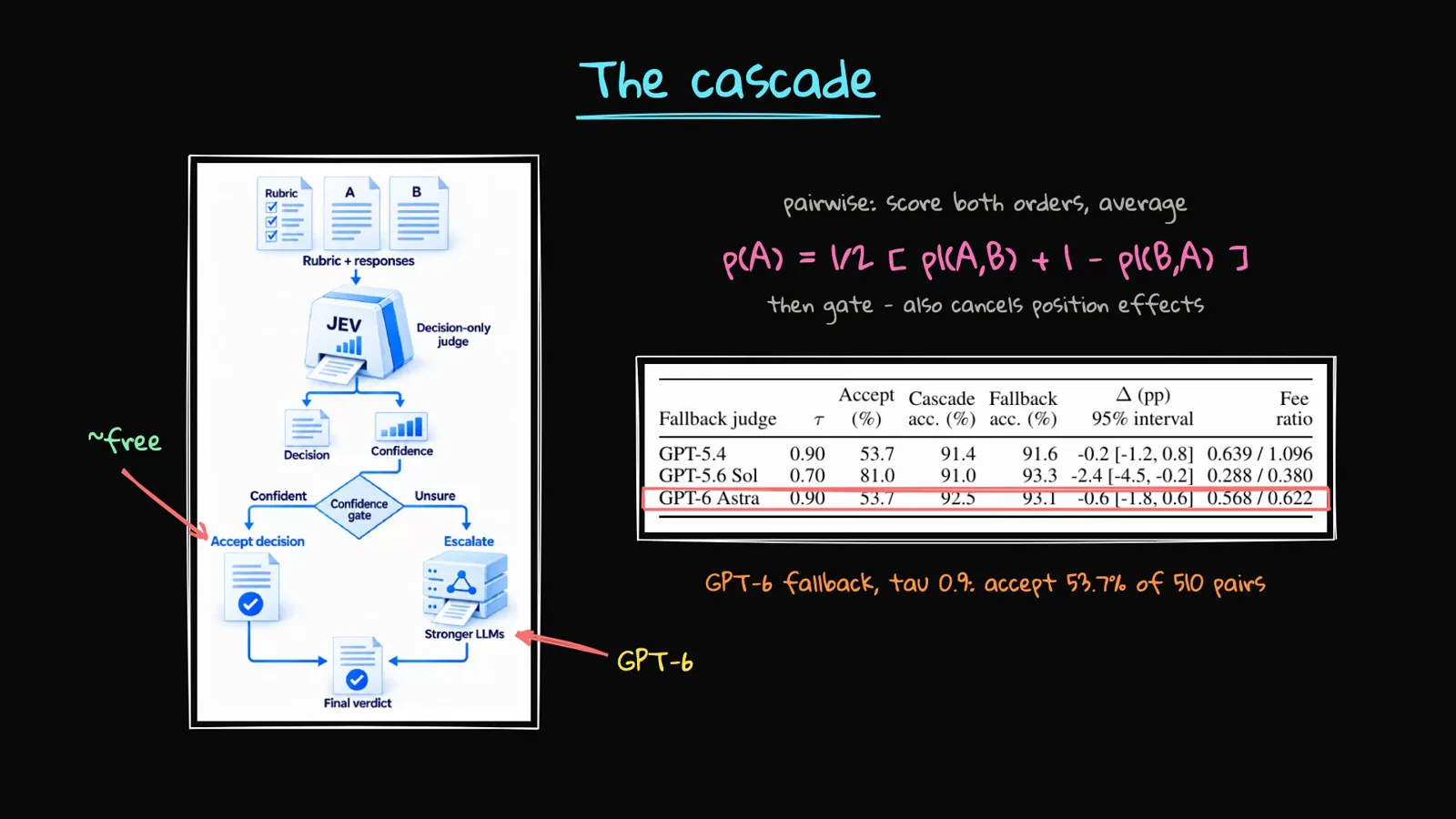
Cheap judge first, strong judge on appeal — and dual-order scoring doubles as debiasing.Watch at 8:02 - 8
Why the threshold must be frozen
The tau is fit on the selection pairs, locked, and tested once on the held-out set. The rule: accept as much as possible while keeping selection-set accuracy within two points of the fallback judge. Freezing is what makes the 53.7% acceptance honest — and it does not always transfer: with GPT-5.6 as the fallback, the chosen 0.7 threshold accepted 81% but lost over two points on held-out data. A threshold is a property of your workload, not of the judge; re-calibrate per task, rubric, and model version.
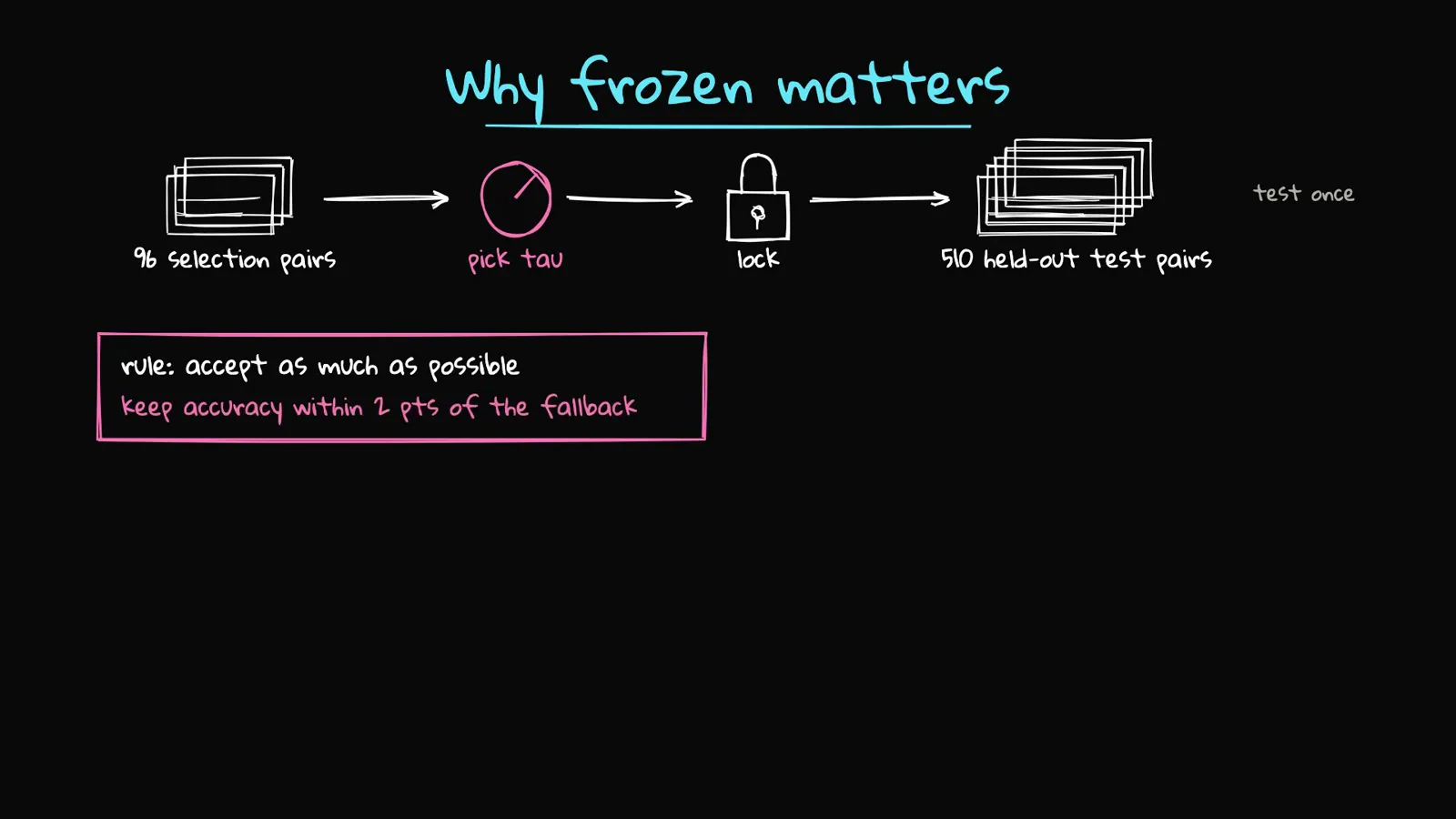
Pick tau on the selection split, lock it, and let the held-out slice deliver the verdict.Watch at 8:22 - 9
A recipe you can run on your own evals
The video distills the paper’s checklist into five steps: one, label a few hundred items from your own traffic and split them into selection and held-out parts; two, run the cheap judge in both orders and bucket the verdicts by confidence to build your own reliability table; three, pick tau against a target — accuracy within two points of your strong judge, or a fixed escalation budget; four, freeze it, recheck on the held-out slice, and treat any invalid verdict as an automatic escalation; five (the channel’s addition), route derivations, code, and long persuasive answers straight to the strong judge, and send reference-free fact checks to evidence or a human.
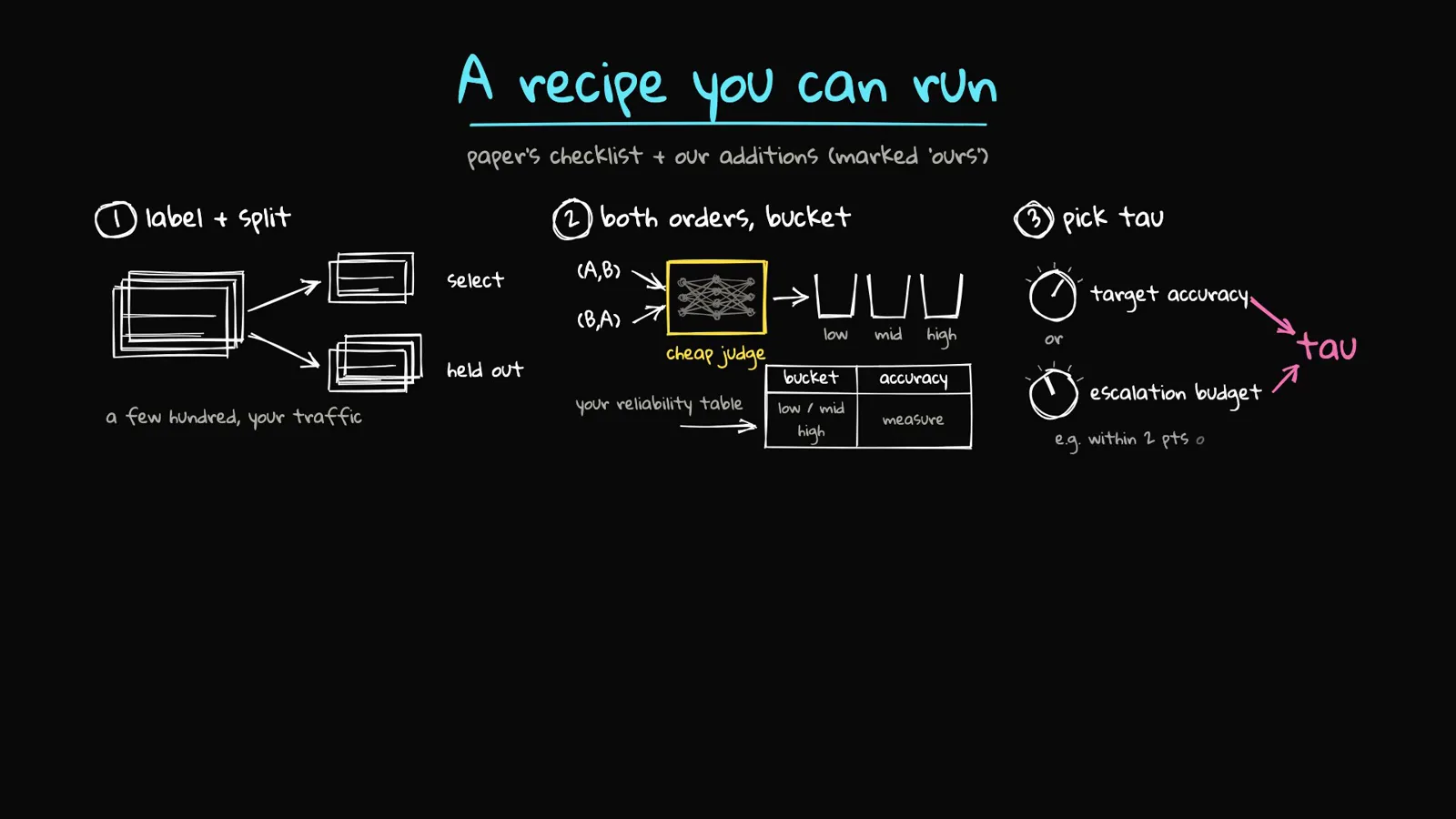
Paper checklist plus two field additions: budget your escalations, and pre-route known-hard categories.Watch at 9:13 - 10
The math, per 1,000 judgments
Blended cost = orders × cheap judge + escalation rate × strong judge. With the paper’s prices (Jev $0.044, GPT-6 $12.18 per 1,000), two orders and the frozen policy’s 46% escalation give 2 × 0.044 + 0.463 × 12.18 = $5.73 — the paper itself measured about 57–58% of the GPT-6 fee, nearer $6.90, because real per-item costs vary: price your escalated slice with real numbers. At a million judgments a month, GPT-6 alone is about $12,180; the cascade lands near half that. A lower threshold trades a point of accuracy for more savings — the dial is yours, as long as you froze it honestly.
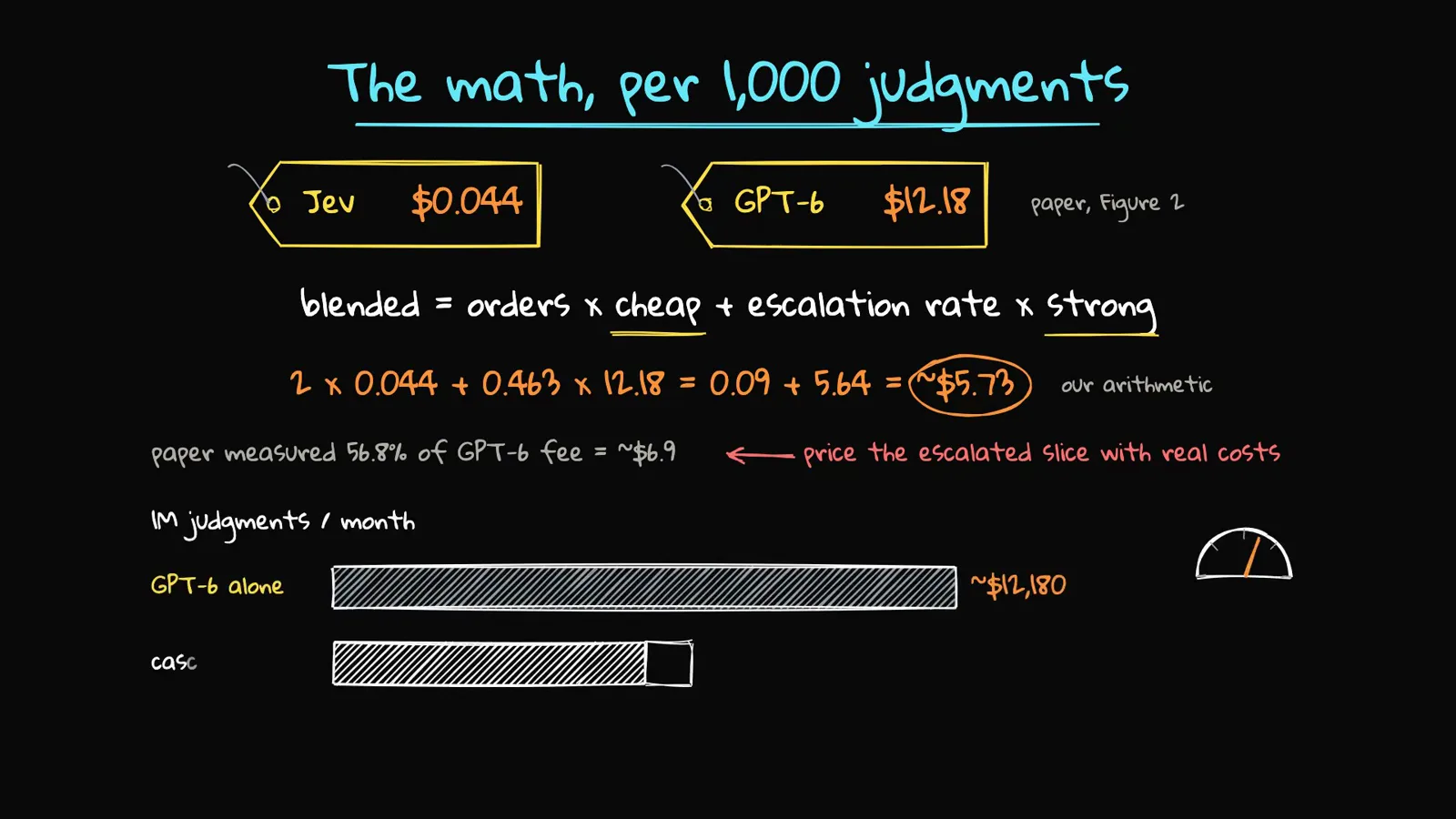
The escalated slice is where the money goes — price it with your real numbers, not the paper’s.Watch at 10:05
Frequently asked questions
Can Jev really replace GPT-6 as an LLM judge?
Not everywhere — and the paper is clear about where. On ordinary preference (RewardBench 92.2 vs 93.5) and evidence-grounded factuality (HaloEval 87.5 vs 86.7) it is within a point at 0.36% of the cost. On hard correctness (JudgeBench 78.6 vs 93.1), style-adversarial pairs, and reference-free prose it loses clearly — those rows belong in the escalate pile.
What is a confidence-gated judge cascade?
A routing pattern where a cheap judge (Jev) scores every item and its confidence decides what happens next: above a frozen threshold the verdict is accepted for almost nothing; below it, the item escalates to a strong LLM judge whose decision is final. In the study the cascade kept over 99% of GPT-6’s accuracy at 57% of its fee.
How do you fix position bias in pairwise judging?
Run both orders and average the aligned probability — p(A) = ½[p(A|A,B) + 1 − p(B|B,A)]. Jev picked the first slot about 48% of the time, so its 3% (RewardBench) and 11% (JudgeBench) flip rates are instability on hard pairs rather than a position lean, and averaging cancels most of it. Because the cheap judge costs $0.044 per 1,000 judgments, scoring twice is still effectively free.
What confidence threshold should I use for a Jev judge?
The one your own calibration table tells you. The paper fit thresholds on a selection split (accuracy within two points of the fallback judge) and froze them before touching test data; in the study, GPT-6 fallback at tau 0.9 accepted 53.7% of held-out pairs. There is no universal number — with a different fallback the same 0.7 threshold lost over two points — so bucket a few hundred labeled items by confidence and pick tau on your traffic.
How much cheaper is Jev as a judge, really?
Per 1,000 judgments: $0.044 vs $12.18 for GPT-6 — 0.36% of the price, with median latency of 0.15 s vs 1.89 s in the paper’s panel. The blended cascade cost with two orders and 46% escalation works out to about $5.73 per 1,000 in the video’s arithmetic (the paper measured ~57–58% of the GPT-6 fee), because each escalated item pays for both judges.
What are the study’s honest limitations?
One proprietary Jev version on public benchmarks with unknown training overlap; benchmark pairs are not your production traces; the cascade results are offline simulations with no live latency measured; the human check was one annotator plus an LLM pass; and calibration did not transfer across tasks — the best threshold differed per workload. Measure on your own traffic before trusting the gate.
Related guides
Jev Regression Testing Guide
The other half of eval discipline: exact decision assertions and CI gates for your own Jev schemas.
ReadLLM Fallback Strategy: Confidence-Gated Degradation Chains
The same gate-escalate pattern applied to production traffic — thresholds, hysteresis, and shadow mode.
ReadJev Benchmarks
Our own reproducible benchmarks — calibration and latency data measured on real workloads.
ReadWhen to Use Jev
The evaluation checklist for deciding where a System One judge fits in your stack at all.
ReadMore video walkthroughs
- Jev Classification Quickstart: OpenRouter API, Primitives & Real Probabilities
- Jev Architecture Explained: Why 70ms Decision Models Beat LLMs for Workflow Automation
- Ultra-Fast Browser Agents with Jev: 178ms DOM Loops & Dual Model Orchestration
- Open Jev Models Are Here: Semif, Nimble, Decider, DiffusionGemma & Laya Hands-On
- Jev vs LLM: Will Jev Replace LLMs? Krish Naik's Whiteboard Explainer
- Jev Trader Tutorial: Build a Subsecond AI Trading Bot on Monad
- Jev Model Router: Build a Privacy-Gated LLM Router with Jev & OpenJev
- Jev Tutorial for Beginners: State, Questions & the TypeScript SDK
- Run Jev Locally: Kev, SemIf & Von on Your Own GPU (OpenJev Guide)
- Jev RAG Reranker: Policy-Steered Reranking for Retrieval-Augmented Generation
- When to Use Jev: An Engineer's Audit of Claims, Gates, and Failure Modes
- LangChain + Jev Integration Tutorial: Routing, Guardrails & Evals
- Jev MCP Server: Connect Jev Decisions to Claude Code & Cursor
- Jev vs Luna: Independent Benchmarks Put "Better, Faster, Cheaper" to the Test
- Jev Agent Harness: Where the Decision Gate Sits in Your LLM Loop
- Jev Playground Walkthrough: The Hotdog Lesson, Criteria, and a Four-Console Token Test
- Jev Text Classification API: Zero-Shot CLI & REST with classifier.dev
- Jev API Examples: First Request, curl & All Three Question Types
- Jev Log Triage with Expanso Edge
- Jev Lead Enrichment with Treg: ICP and Signup Scoring
- Use Jev Decision Nodes in Heym for Model Routing
- Laya Tutorial: Open-Source AI Routing With Calibrated Probabilities (Laya vs Jev Setup)
- Train Your Own Jev: Fine-Tune a Jev-Style Decision Model for $5–$17 (What You Can and Cannot Train)
- Jev Tips: 8 Best Practices for Better Decisions (State, Questions, Criteria & Thresholds)
- Jev Context Compaction: Prune AI Agent Memory Without Generative Summaries
- TypeSafe Computer Use: Local Desktop Automation with Jev, Step by Step